
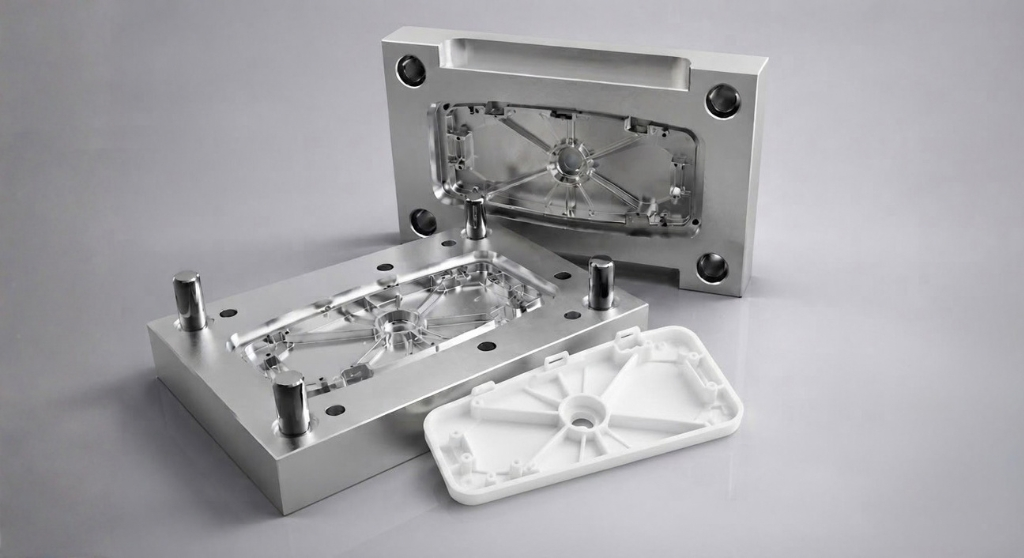
Choosing between soft tooling and production tooling matters as much as material selection does for a medical device moving toward its first production run. Soft tooling uses aluminium or unhardened steel moulds, production tooling uses hardened steel, and neither is the automatic right answer. It comes down to volume, timeline, and how settled the design actually is.
For a device with a clinical trial or field-test deadline approaching, and final production volume not yet confirmed, that usually points toward soft tooling: parts in production-intent material, without the cost or lead time a hardened tool demands.
Marcopolo supports medical-device companies from concept to production: prototyping, soft tooling, production tooling, injection moulding, assembly, and low-volume manufacturing.
Need a first production batch?
What is soft tooling?
Soft tooling uses aluminium or un-hardened steel moulds to produce injection-moulded parts. These materials can be machined faster than hardened tool steel, allowing a tool to be built or modified while the design is still evolving.
Soft tooling delivers functional prototypes and low-volume production in production-intent material, with tool life up to 50,000 shots and a lead time of 2 to 6 weeks, at roughly half the cost and lead time of production tooling.
Material selection starts with sterilisation
For medical devices, tooling decisions cannot be separated from material selection. Marcopolo processes engineering and high-performance polymers in biocompatible grades: PP (medical grade homopolymer) for syringes and flexible hinges, ABS and PC-ABS for housings, PC (Makrolon Rx grades) for transparent covers and high-strength housings, TPU (Pellethane, Tecoflex) for seals and flexible components, PPSU (Radel PPSU) for repeat-sterilisation instrument housings, and ULTEM (USP Class VI, Ultem 1010) for high-performance sterilisable housings.
The right grade should be confirmed against the device’s sterilisation method, load, and intended use before it’s specified in any document.
Need to select a material before tooling?
Soft tooling vs hard tooling
Soft tooling supports fast validation and smaller first production runs. Hard tooling is designed for durable, sustained production after the design and process are stable.
| Parameter | Soft tooling | Production or hard tooling |
| Tool material | Aluminium or un-hardened steel | Hardened tool steel |
| Typical tool life | Project dependent; Marcopolo states up to 50,000 shots for its soft-tooling reference | Built for regular, sustained production |
| Lead time | Typically 2–6 weeks in the draft’s planning range | Typically 5–8 weeks in the draft’s planning range |
| Initial cost | Lower | Higher |
| Design flexibility | Easier to modify | Changes after design freeze are costly |
| Best fit | Validation, pilot batches, early production | Committed, high-volume production |
| Main consideration | Tool wear and process differences | Higher sunk cost if the design changes |
The lead times and tool-life figures above are planning references from the draft, not universal guarantees. Final values depend on part size, geometry, material, tool design, finish, machine, and inspection requirements.
Where soft tooling delivers value
Soft tooling is valuable when a medical-device team needs:
- Functional prototypes and pilot batches in the actual production material.
- Clinical or field-test batches before the design is fully frozen.
- Low-volume production from hundreds to thousands of units.
- Design and manufacturability validation before committing to a hardened tool.
- A first production run while demand is still being established.
- Reduced upfront tooling investment for early market supply.
Marcopolo’s medical-device capability includes cost-efficient soft tools engineered with production intent and flexible MOQs to match market demand.
Launching with a soft tool while production tooling is built
A common route is to launch the first production batch with a soft tool while the hardened production tool is built in parallel. This can supply the early market without waiting for the complete production tooling programme.
When the production tool comes online, the changeover should be treated as a controlled tool transfer—not a simple swap. Compare the original and new parts for:
- Critical dimensions and tolerances.
- Material grade and processing conditions.
- Surface finish and visible parting lines.
- Fit, function, and assembly.
- Shrinkage, warpage, and critical features.
- First-article inspection results.
- Documentation and engineering-change records.
A change in tooling can alter cooling, shrinkage, gate design, surface finish, and process parameters. The new tool may therefore require additional qualification or validation within the device quality system.
Soft Tooling and Production Tooling: Different Tools for Different Stages
Soft tooling and production tooling solve different problems. Soft tooling, in aluminium or mild steel, is built for validation, pilot batches, and early production, low tool cost, high design flexibility, and a tool life of hundreds to low thousands of shots. Production tooling, in hardened steel, is built for committed, high-volume production, holding up past 100,000 shots.
Neither is a lesser version of the other. Each is built for the stage it’s meant for, the design’s maturity and the volume actually needed decide which one fits.
Where this fits in the bigger picture
Soft tooling sits in the middle of the journey from concept to production. Earlier stages, 3D printing, vacuum casting, and RIM, validate form, fit, and functional behaviour before a design is fully settled. Soft tooling takes over once a design needs production-intent material in real, testable batches, for pilot runs, regulatory submissions, and early production. Production tooling takes over once demand is established and the design is final.
Marcopolo supports every stage of this journey under one roof, from first concept to production launch.
Ready to move from validated design to first production batch?
Conclusion
The decision between soft tooling vs hard tooling should follow the device’s maturity, material, sterilisation method, quantity, validation plan, and expected production life.
Soft tooling is often the practical choice when a medical-device manufacturer needs production-intent parts for clinical or field testing, pilot supply, or a first production run before demand is established. Hard tooling becomes more appropriate when the design is stable, the process is qualified, and sustained production justifies the higher investment.
A successful programme plans the transition early, confirms the material against sterilisation requirements, compares parts made from both tools, and documents every engineering, inspection, and process change.
Need help choosing the right tooling route?
FAQs
What is the difference between soft tooling and hard tooling?
Soft tooling uses aluminium or un-hardened steel for faster, lower-investment tools suited to validation and early production. Hard tooling uses hardened tool steel for durable, sustained production.
Is soft tooling suitable for medical-device production?
It can be suitable for selected pilot batches, clinical or field-test parts, first production runs, and low-volume manufacturing when the material, process, inspection, and validation requirements are defined.
Why use soft tooling for a first production run?
It allows the manufacturer to produce production-intent parts before committing to a high-cost hardened tool, which is helpful when demand or design decisions are still developing.
How many parts can a soft tool produce?
Tool life is project-specific. Marcopolo’s published soft-tooling reference states up to 50,000 shots, but the actual result depends on tool material, geometry, resin, process, maintenance, and quality requirements.
How long does soft tooling take?
The draft’s planning range is 2–6 weeks, but actual lead time depends on design approval, tool complexity, material, finish, inspection, and production requirements.
Can soft tooling use the actual production material?
Yes, where the tool, machine, material, and process are suitable. The exact grade and production requirements must be confirmed before release.
Can soft-tool parts be used for regulatory submissions?
They may be appropriate for a specific validation or submission build, but acceptance depends on the device, material, process, documentation, and regulatory strategy. Confirm with the quality and regulatory team.
When should a company choose hard tooling?
Hard tooling is better when the design is stable, the material and process are approved, volume is sustained, and long-term tool life and unit economics justify the investment.
Does switching from soft to production tooling require revalidation?
It may. Tool material, cooling, shrinkage, gates, surface finish, and process conditions can change. The new tool should be compared and qualified under the applicable quality system.
What documents should be requested for a first production batch?
Depending on the project, request material certificates, batch traceability, dimensional inspection, first-article reports, process documentation, and engineering-change records. Confirm the exact documentation package with the medical-device team.