
When a product development program reaches the stage of functional testing, endurance validation, or regulatory submission, the parts need to behave exactly like production parts. Same material. Same wall thickness. Same mechanical response.
3D printing and vacuum casting serve earlier stages well — geometry review, fitment checks, CMF evaluation. But neither delivers parts in actual engineering plastics. When the test requires the real material, soft tooling and injection moulding is the right process for any functional prototype that must perform under real-world conditions.
What Is Soft Tooling?
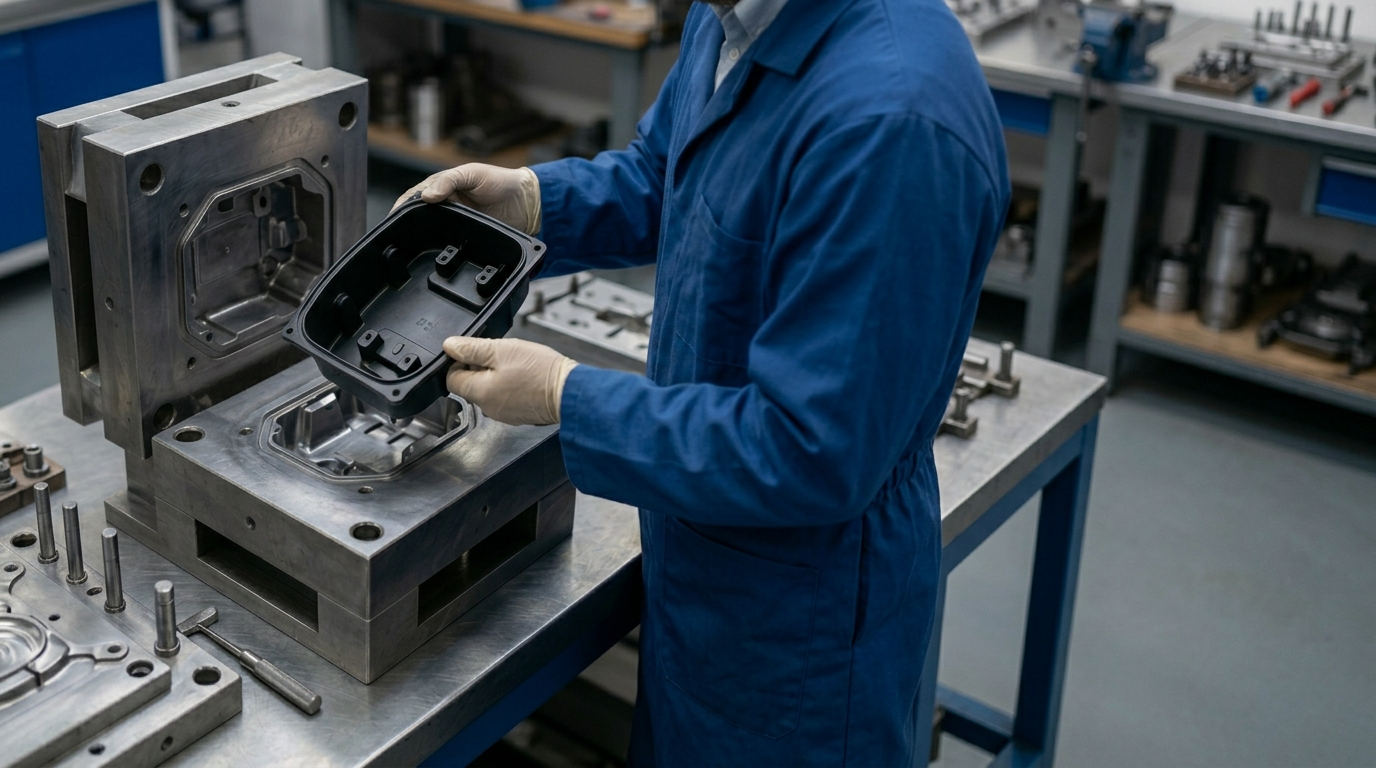
Soft tooling refers to injection moulds machined from aluminium or unhardened steel — EN31 or P20 — rather than the hardened steel used in production tooling. The mould produces parts through standard injection moulding, in the same engineering plastic grades used in final production.
The trade-off is tool life. A soft tool supports the quantities needed for testing, validation, and pre-series builds — far fewer than the hundreds of thousands of shots a hardened production tool is designed for. The lower tooling cost and shorter lead time make it the most practical option at that stage of development.
For any functional prototype requiring genuine material properties, soft tooling delivers where additive manufacturing cannot.
Why Soft Tooling Is the Right Choice for Functional Prototype Parts
Parts in Actual Engineering Plastics – Including ABS Materials and Nylon Materials
This is the core reason. Soft tooling delivers injection-moulded parts in the exact material grade the final product will use. Unlike 3D printing, which uses SLA materials that are photopolymer approximations, soft tooling gives you true thermoplastics.
Common engineering plastics for functional prototype parts:
| Material Category | Specific Grades | Best For |
|---|---|---|
| ABS materials | ABS, ABS-PC | Interior trim, housings, enclosures |
| Nylon materials | PA6, PA66, glass-filled PA | Gears, brackets, structural components |
| Polycarbonate | PC, PC-ABS | Transparent covers, impact-resistant parts |
| Polypropylene | PP, talc-filled PP | Automotive interior, fluid handling |
| High-performance | POM, PPS, PSU, PEEK, ULTEM | High-heat, chemical-resistant applications |
| Flame-retardant | FR-rated ABS, PC, PA | Electrical enclosures, EV components |
| Elastomers | TPE, TPU | Over-moulding, seals, grips |
No polyurethane approximations. No resin equivalents. The functional prototype that goes into your test rig, endurance chamber, or regulatory submission is made from the same ABS materials or nylon materials as the production part.
Lead Time of 2-6 Weeks
Soft tools are ready in 2-6 weeks from design freeze — significantly faster than hardened production tooling. For programs under timeline pressure, this means functional parts in hand while the program is still in active development, not after it has moved on.
50% Lower Investment Than Production Tooling
Soft tooling reduces tooling investment and lead time by 50% compared to production tools. For programs that need real material parts but are not yet ready to commit to production tooling — because the design is still being refined or volumes are not yet confirmed — this is the most cost-effective path to functional prototype validation.
DFM and Moldflow Built In
Every soft tool at Marcopolo goes through DFM review and Moldflow analysis using Moldex3D, with tool design managed in VISI, Creo, and Siemens NX before machining begins. Manufacturability issues are identified and resolved before the tool is cut — not discovered during trials.
Texturing and Finish as Required
Soft tools can be post-processed for the required surface finish and texture as per 2D specifications — the same as production tools. Parts coming off a soft tool can match the intended final aesthetic, not just the functional requirement.
In-House ECN Management
Design changes happen during development. Marcopolo’s in-house team manages tool updates and engineering changes with tool update tracking, keeping the tool aligned with the latest design revision throughout your functional prototype program.
When Soft Tooling Makes Sense for Your Functional Prototype
| Requirement | Soft Tooling |
|---|---|
| Parts in actual engineering plastic (ABS, nylon, PC, etc.) | Yes |
| Functional and endurance testing | Yes |
| Regulatory submission samples | Yes |
| Pre-series and homologation builds | Yes |
| Quantity range 100-5,000 parts | Yes |
| Design still being refined | Yes — lower commitment than production tooling |
| Production tooling delayed | Yes — keeps supply running |
| Mass production at high volumes | No — production tooling required |
Material Differences for Validated Parts
Understanding material differences is critical when selecting the right process. This is especially important when deciding between a functional prototype made via soft tooling versus a visual model from additive manufacturing.
SLA Materials vs ABS Materials vs Nylon Materials -What's the Difference for Functional Prototypes?
Understanding material differences is critical when choosing the right process for your functional prototype.
| Property | SLA (3D Printing) | ABS Materials (Injection Moulded) | Nylon Materials (Injection Moulded) |
| Material type | Photopolymer resin | Thermoplastic | Thermoplastic |
| Production process | 3D printing (SLA) | Injection moulding | Injection moulding |
| Tensile strength | 40–60 MPa | 40–50 MPa | 50–85 MPa |
| Elongation at break | 5–15% | 10–50% | 20–200% |
| Heat deflection temp | 40–60°C | 90–105°C | 80–180°C |
| UV resistance | Limited for long-term use | Good | Good |
| Chemical resistance | Limited for aggressive environments | Moderate | Excellent |
| Suitable for functional testing? | No | Yes | Yes |
| Suitable for visual prototypes? | Yes | Greater than needed | Greater than needed |
Key takeaway: SLA resins are well-suited for visual and form-fit models. ABS-grade materials and nylon-based resins from soft tooling are appropriate for actual load-bearing and environmental testing. For any parts for functional validation, soft tooling is the right choice.
Industries Where We Use Soft Tooling for Functional Prototype Parts
Automotive
Pre-series and homologation builds, endurance testing of interior and exterior components, proto-vehicle supply when production tooling is delayed. Soft tooling serves validation and pre-series stages — not mass production supply.
Common ABS materials used: ABS, PC-ABS for interior trim
Common nylon materials used: PA6 GF30 for structural brackets
Medical Devices
Regulatory submission samples in biocompatible grades including PC, PSU, and PEEK. Low-volume production of device housings and enclosures.
Industrial Electronics
Smart meter and IoT enclosures, switchgear housings, and telecom equipment covers in FR-rated and ESD-safe grades at low MOQ.
Robotics and Industrial Equipment
Structural housings and covers in high-performance engineering plastics for functional testing before committing to production volumes.
Accelerate product development with soft tooling.
Soft Tooling vs Alternative Processes for Functional Prototypes
| Process | Material | Lead Time | Quantity | Best For |
|---|---|---|---|---|
| Soft tooling | True ABS, nylon, PC, etc. | 2-6 weeks | 100-5,000 | Functional prototype testing |
| SLA 3D printing | SLA materials (photopolymer) | 1-3 days | 1-10 | Visual prototypes only |
| SLS/MJF 3D printing | Nylon powder | 3-5 days | 1-50 | Functional screening (not full validation) |
| Vacuum casting | Polyurethane | 5-10 days | 10-50 | Bridge quantities, not real materials |
| Production tooling | True ABS, nylon, PC, etc. | 8-16 weeks | 50,000+ | Mass production |
When you need a functional prototype that behaves exactly like a production part, soft tooling bridges the gap between visual models and mass production.
Test Your Design with Confidence for Manufacturing
Our team will review your design, run DFM and Moldflow analysis, and recommend the right tooling approach for your program. Whether you need ABS materials for interior components or nylon materials for structural parts, we deliver.
Marcopolo – Your Partner from Tool Design to Production
With 25+ years of tooling and moulding experience and 1,400+ tools developed, Marcopolo manages the full process in-house — from DFM and Moldflow through soft tooling, injection moulding, and transition to production tooling. One partner, one continuous program, no handoffs.
Our Complete Service Offering for Functional Prototype Parts:
| Service | Description |
|---|---|
| DFM Analysis | Design for Manufacturability review before tooling |
| Moldflow Analysis | Moldex3D simulation to predict fill, warp, and cooling |
| Soft Tooling | Aluminium and P20 steel moulds for 100-5,000 parts |
| Injection Moulding | ABS materials, nylon materials, PC, POM, PEEK, and more |
| Production Tooling | Hardened steel moulds for high-volume production |
| Post-Processing | Texturing, painting, assembly, and packaging |
Why Choose Marcopolo for Your Functional Prototype?
-
25+ years of tooling and moulding experience
-
1,400+ tools developed across automotive, medical, electronics, and industrial sectors
-
In-house DFM and Moldflow – no external handoffs
-
True engineering plastics – not approximations
-
Single partner from prototype to production
Get a Quotation – Ready to move beyond resin approximations? Let’s talk about soft tooling for your next validation program. Whether you need ABS materials, nylon materials, or any engineering thermoplastic, we deliver functional prototypes you can test with confidence.
FAQs
What is the difference between ABS materials and nylon materials for prototypes?
ABS materials offer good impact resistance and surface finish, ideal for housings and interior trim. Nylon materials offer higher strength, heat resistance (up to 180°C), and chemical resistance, ideal for gears, brackets, and under-hood components. Soft tooling can produce both.
How many parts can I produce with soft tooling?
Soft tooling typically supports 100-5,000 parts before tool wear becomes significant. For a functional prototype program requiring 500 parts for testing and pre-series builds, soft tooling is ideal. For mass production above 50,000 parts, hardened production tooling is required.
How long does soft tooling take?
Soft tools are ready in 2-6 weeks from design freeze, depending on part complexity and cavity count. This includes DFM review, Moldflow analysis, tool design, and machining. Marcopolo’s in-house team manages the entire timeline.
Can soft tooling produce parts with texture and specific surface finish?
Yes. Soft tools can be post-processed for the required surface finish and texture as per 2D specifications — the same as production tools. Parts coming off a soft tool can match the intended final aesthetic.
What industries use soft tooling for functional prototypes?
Automotive (pre-series builds, homologation), medical devices (regulatory submissions), industrial electronics (smart meters, enclosures), robotics (structural housings), and consumer products.