
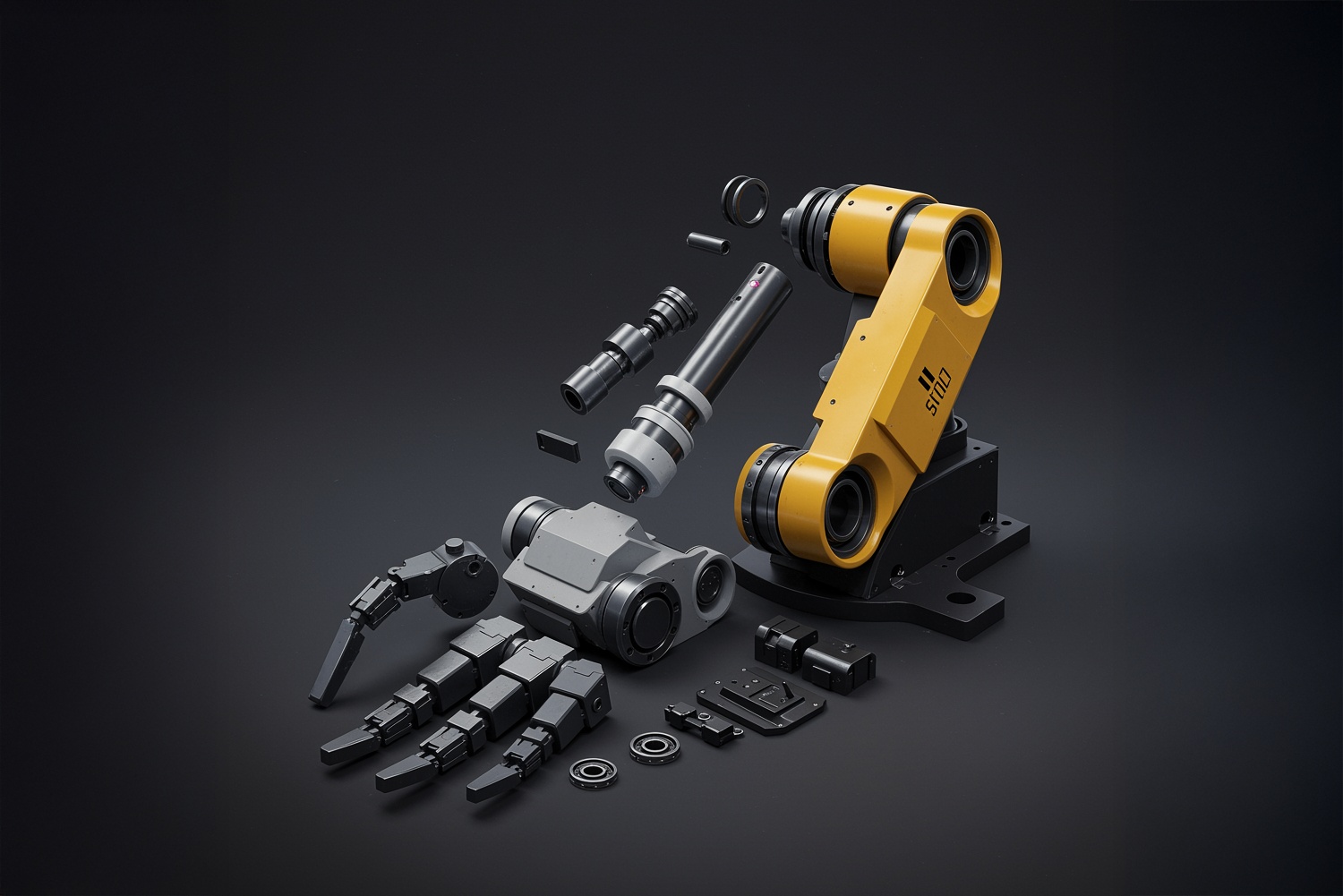
Building a robot requires precision on two fronts: code and components. Your engineering team excels at one. Specialized manufacturers excel at the other. Most robotics companies today outsource component manufacturing; not to cut corners, but to move faster, manage uncertainty, and avoid premature production commitments. Rapid prototyping and low-volume production allow teams to validate designs, deploy pilots, and supply early customers while products continue to evolve.
Low-volume production enables robotics companies to manage inventory exposure and mitigate commercial risk. This guide explains how prototyping and low-volume production work together in robot components manufacturing as a combined process at the early stage of validating a design before committing to it.
We support robotics teams from rapid prototyping through low-volume production
What Are "Robot Components"? Common Parts Manufacturers Build
Robot components span mechanical structures, motion elements, and protective housings. They are rarely standardized and often evolve multiple times before stabilization.
Here are the core categories of manufactured robotic parts:
Structural Components
Chassis and Bases
Load-bearing frames that support motors, electronics, and payloads. Mobile robots demand lightweight stiffness, while stationary systems require rigidity and stability.
Arm Segments and Links
Hollow sections, brackets, and joint housings connecting kinematic chains. These parts balance strength, weight, and manufacturability.
Mounting Plates and Brackets
Interface components that align motors, actuators, sensors, and electronics with the main structure.
Motion Components
Gripper Fingers and Jaws
End-effector components are designed for repeated cycles, wear resistance, and precise geometry.
Rotating Joints and Couplings
Precision parts that enable smooth motion while minimizing backlash and misalignment.
Enclosures and Housings
Sensor Housings
Protective covers for cameras, LIDAR, control boards, and wiring. These parts must fit accurately, protect components, and often meet environmental constraints.
A typical robot contains 20–100+ unique manufactured parts, most of which are produced externally to maintain flexibility during development.
Prototyping and Low-Volume Production: One Continuous Journey
Robotics manufacturing rarely follows clean phases. Designs evolve late. Volumes remain uncertain. Early builds often serve multiple purposes, including testing, pilot deployment, and even initial customer supply.
Rather than separating “prototyping” and “production,” successful robotics teams treat them as a single, continuous manufacturing journey.
- These functional prototypes often transition directly into early production supply.
- Design changes continue through pilot and early commercial stages.
- Volumes grow cautiously, aligned to real-world demand.
- Manufacturing methods adapt as the product matures.
Marcopolo supports robotics programs across this journey, supporting production-ready parts at low volumes, even as designs continue to evolve.
Manufacturing Methods: Flexibility at Every Stage
The right partner offers multiple manufacturing methods (not as disconnected options), but as an integrated toolkit that grows with your product.
1. 3D Printing SLA, SLS, MJF (Fast Prototyping & Iteration)
- Turnaround: 24-48 hours from CAD to finished part
- Cost: No tooling costs (ideal for prototypes)
- Materials: Production-grade nylon, resins, flexible materials
- Best for: Rapid iteration on gripper fingers, housings, complex geometry
- Design freedom: Change geometry, test materials, iterate daily
2. CNC Machining (Pinpoint Accuracy & Strength)
- Tolerances: ±0.1mm (critical for bearing interfaces, coupling blocks)
- Materials: Aluminum, PEEK, stainless steel, engineering plastics
- Timeline: 5-7 days for functional parts
- Best for: Rigid arm links, gripper bases, precision mounts
- No post-processing: Smooth surface finishes, ready to use
3. Vacuum Casting (Flexible Low-Volume Production)
- Timeline: Production kick-off is 1–2 weeks
- Quantities: 10-500 units
- Materials: Polyurethane (PU) casting grades formulated to replicate engineering plastics and elastomers, including rigid, impact-resistant, and flexible variants
- Tooling cost: 4 to 6 times less than injection molding
- Best for: Pilot robot builds, field testing, early customer deployments
- Design changes: If pilot testing reveals improvements, modify tooling inexpensively and remanufacture
Note: PU grades can be selected and tuned for strength, impact resistance, surface finish, and flexural behavior, making vacuum-cast parts suitable for functional and production-intent use at low volumes.
4. Reaction Injection Molding or RIM (Large Covers & Enclosures)
- Strong & durable parts: Made with PU that’s formulated to closely replicate engineering plastics and elastomers.
- Large parts: Protective covers, enclosures, chassis shells, humanoid robot covers
- Tooling cost: Lower than injection molding; suitable for low-volume production
- Quantities: 10-500 units cost-effectively
- Best for: Components that need strength and durability at low volumes
- Flexibility: Design modifications don’t require expensive retooling
5. Soft Tooling (Pilot & Pre-Series Production)
- Cost: 50-70% less than steel tooling
- Flexibility: Tooling can be modified if designs evolve (critical in robotics)
- Timeline: Faster than steel tooling; supports rapid manufacturing scaling
- Quantities: 100-5,000 units
- When to use: Pilot production, pre-series supply, early commercial, when design is still evolving
- Bridge solution: Perfect bridge between prototyping and early commercial supply
6. Assembly & Integration (End-to-End Solution)
- Multi-part assembly: Mechanical assembly with electronics integration
- Wiring & connectors: Harness integration, connector mounting
- Assembly and fitment coordination: From early prototypes to low-volume production runs
- Scalable support from early prototypes through controlled low-volume production.
- Single-source accountability for coordination, fit, and part-level consistency
Key Factors Engineering Teams Evaluate When Outsourcing
1. Design-for-Manufacturability (DFM) Expertise
A good manufacturing partner analyzes your CAD files and optimizes designs for manufacturability. They identify wall-thickness issues, suggest material changes, and warn about potential failure points before production starts.
Why this matters: A gripper design optimized for DFM might use slightly less material but last 2x longer under cyclic loading.
2. Material Science Knowledge
Different robot applications demand different materials:
- Nylon: Excellent for wear, affordable, suitable for high-cycle parts
- PEEK: High-temperature stability, ideal for aerospace/defense robotics
- Flexible elastomers: Critical for soft robotics and collaborative grippers
- Engineering-grade composites: Weight reduction for mobile robots
Get Initial DFM Input For Your Design
3. Turnaround Time
Prototyping velocity directly impacts time-to-market. A 48-hour 3D print turnaround vs. a 2-week turnaround determines whether you iterate weekly or monthly.
4. Quality Consistency Across Iterations
Mass-produced robot parts must be identical. Tolerance stack-up across multiple components can degrade performance. A manufacturing partner focused on dimensional accuracy, material consistency, and repeatable processes helps maintain part quality across iterations and low-volume builds.
Providing Rapid Prototyping Support for 25+ Years
Conclusion: Why Outsourcing Is the Smart Play
Building robot component manufacturing infrastructure distracts from your core mission: great robots. On the other hand, outsourcing robot component manufacturing to specialists offers:
- Speed: Prototypes in days, production parts in weeks
- Cost efficiency: No capital outlay for equipment
- Quality: DFM expertise, material science, process discipline, DFM expertise, and consistency
- Flexibility: Iterate rapidly without financial penalty
- Scalability: Same partner grows with you from early to low-volume growth
The goal is for the robot companies to focus on software, design, and customer delivery; therefore, they should outsource the manufacturing to 3D printing, machining, and rapid prototyping experts (best if they can find it in a single manufacturing partner).
Validate Your Robot Parts in Production-Grade Materials
FAQs
How quickly can you prototype a custom gripper component?
24-48 hours for 3D-printed prototypes (SLS nylon, flexible resins). For CNC-machined parts, 5-7 days. This allows you to iterate on designs weekly rather than monthly.
What's your minimum order quantity?
We support flexible MOQs starting at low hundreds, allowing pilot testing before committing further. This means you can pilot-test with a few hundred units before committing to large production runs.
How quickly can we get prototypes for testing?
24-48 hours for 3D-printed prototypes (SLS nylon, flexible resins). 5-7 days for CNC-machined parts with critical tolerances. This allows you to iterate weekly on designs and get production-intent prototypes into customers’ hands for field testing.
What is soft tooling, and when should we use it?
Soft tooling uses aluminum or softer materials instead of expensive steel. Cost is 50-70% less than steel tooling. It’s perfect for pilot production, pre-series supply, and early commercial quantities, especially when you expect design changes based on field feedback. If modifications are needed, soft tooling can be updated faster and cheaper than steel tooling.
What materials do you recommend for robotics applications?
It depends on application and stage: SLS nylon for high-cycle load-bearing parts, PEEK for high-temperature requirements, flexible elastomers (TPU) for soft robotics grippers, and aluminum for precision fixtures and bearing interfaces. We provide material recommendations as part of our DFM analysis based on your specific application and evolution stage.