
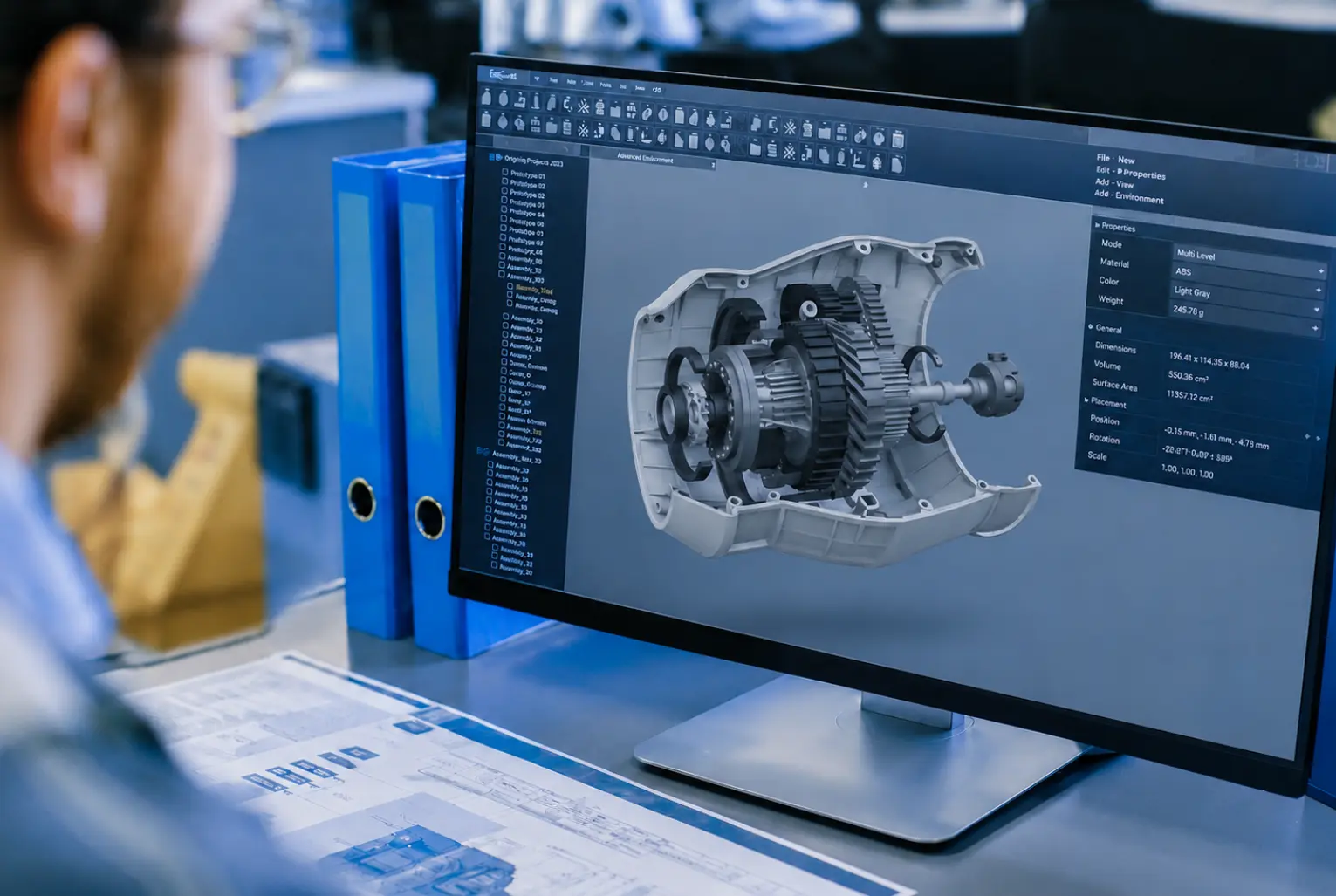
Mechanical design services play a critical role in turning product ideas into manufacturable, reliable, and production-ready components. In product development, the difference between a part that works on screen and a part that performs in production often comes down to the quality of the engineering decisions made early.
For companies developing plastic and metal components, mechanical design services go far beyond CAD modelling. They shape product function, manufacturability, tooling feasibility, performance, and long-term production efficiency, which is why they matter across the full prototype-to-production journey.
What are mechanical design services?
Mechanical design services cover the engineering work needed to transform a concept into a part that can be tested, manufactured, assembled, and scaled. This usually includes product strategy, CAD development, tolerance planning, DFM, mechanism design, mould design support, material selection, and engineering validation.
At Marcopolo, this engineering layer is closely tied to rapid prototyping, tooling, injection moulding, and low-volume production support, which helps reduce the gap between design intent and manufacturing reality. That integrated approach is especially valuable for companies that want faster development and fewer late-stage corrections.
Why mechanical design services matter
A product can look correct in CAD and still fail in manufacturing. Common problems such as weak ribs, inconsistent wall thickness, poor draft, thermal instability, poor fastening logic, and tool-unfriendly geometry often appear only when engineering depth is missing.
Mechanical design services help teams reduce design risk, improve product performance, shorten development cycles, and avoid expensive tooling changes.
Need stronger engineering support early?
What mechanical design services include
A complete mechanical design services scope usually covers multiple stages of product development. Instead of treating design as only a CAD activity, strong teams connect engineering decisions directly to testing, tooling, and production.
| Service Area | What It Includes | Why It Matters |
|---|---|---|
| Product Strategy | Functional requirements, use conditions, and volume expectations | Prevents misalignment early in development |
| Industrial-to-Mechanical Translation | Converting styling intent into manufacturable geometry | Balances aesthetics and performance |
| Mechanism Development | Hinges, snaps, latches, load paths, and moving features | Improves function and reliability |
| Multidisciplinary Integration | PCB space, thermal needs, fastening, and packaging constraints | Avoids conflicts between engineering teams |
| DFM & Moldflow Analysis | Wall thickness, gate logic, ejection, sink, and warpage review | Reduces tooling risk and minimizes rework |
| Part & Mould Design | Production-ready part design and tooling direction | Supports repeatable and scalable manufacturing |
| Reverse Engineering | 3D scanning, tolerance analysis, and design intervention to improve performance and manufacturability | Ideal for legacy products, redesigns, and product improvement projects |
Product strategy and design definition
Every good product starts with a clear design brief. Mechanical design services begin by defining how the product will be used, what loads it must withstand, what environmental conditions it will face, and how it will be manufactured.
These inputs matter because every downstream decision depends on them. If the design brief is incomplete, the result is usually a part that looks finished but creates avoidable issues during testing or tool design.
Mechanism and performance development
Many product failures happen because the mechanism is not resolved early enough. Snap fits, clips, hinges, latching features, sealing logic, and load paths all need engineering evaluation before the design is frozen.
Mechanical design services help identify these risks before tooling starts. That is especially important when the same part must meet both performance and production constraints, which is common in automotive, industrial, electronics, and appliance applications served by Marcopolo.
DFM and moldflow support
Design for manufacturability is one of the most valuable parts of mechanical design services. It helps determine whether a part can be produced consistently, economically, and at the required quality level.
Marcopolo’s site specifically highlights DFM support, mould design engineering, and moldflow analysis as part of its tooling capability. That matters because issues such as sink marks, warpage, poor filling, ejection difficulty, and incorrect gate placement are far cheaper to fix in the design stage than after a tool is cut.
| Common DFM Issue | Typical Impact |
|---|---|
| Uneven Wall Thickness | Sink marks, warpage, and inconsistent cooling |
| Low Draft Angle | Ejection issues and increased tool wear |
| Poor Rib Design | Reduced strength and cosmetic defects |
| Incorrect Gate Location | Flow marks and uneven material filling |
| Undercuts Without Planning | Increased tooling complexity and higher manufacturing costs |
| Weak Boss Geometry | Fastener failure and cracking |
Want better DFM before tool release?
Part design and mould design connection
A good part design is not automatically a good mould design candidate. Mechanical design services must consider how the part will be gated, cooled, ejected, vented, and maintained in production.
This is where integrated manufacturing knowledge becomes important. Marcopolo’s tooling and injection moulding capability makes it easier to connect part design with actual production constraints, which helps teams reduce costly rework and improve launch readiness. When product design and tool design are handled with shared engineering logic, the result is usually faster approvals and fewer trial-stage surprises.
Why integrated engineering matters
The biggest advantage of strong mechanical design services is not just better drawings. It is better coordination between design, prototyping, tooling, and manufacturing.
Marcopolo’s overall positioning is built around being a one-stop solution for design support, prototyping, tooling, and scalable low-volume production with shorter lead times and engineering feedback built into the process. That makes integrated engineering especially useful for teams that need to move quickly without sacrificing manufacturability.
Mechanical design services across development stages
|
Development stage |
Role of mechanical design services |
|---|---|
| Concept stage | Define product architecture and constraints |
| CAD stage | Build functional geometry and assembly logic |
| Prototype stage | Validate form, fit, and function |
| DFM stage | Refine the part for manufacturability |
| Tooling stage | Align the design with mould design logic |
| Production stage | Reduce variability and support repeatability |
This table helps clarify that mechanical design services are not a one-time activity. They influence every stage from concept to production.
Why this matters for business outcomes
Mechanical design services directly affect launch speed, part quality, tooling cost, and long-term manufacturability. Better engineering decisions early in development usually mean fewer mould changes, faster prototype validation, and fewer delays when the product moves to production.
For businesses developing plastic parts, assemblies, and engineered components, this makes mechanical design services a strategic capability rather than a support task. That is especially true when the partner can support both design intent and manufacturing execution under one roof.
Need faster design-to-production support?
FAQs
What do mechanical design services include?
Mechanical design services typically include CAD development, mechanism design, tolerance planning, DFM, mould design support, material selection, and validation planning.
Why are mechanical design services important?
They help ensure that the part is functional, manufacturable, and ready for testing or production without avoidable design errors.
How do mechanical design services improve manufacturing?
They reduce problems such as poor toolability, weak geometry, warpage, sink, and assembly issues by solving them earlier in the design stage.
Are mechanical design services only for new products?
No. They are also useful for redesigns, reverse engineering, cost optimisation, and improving existing products for better manufacturability.