
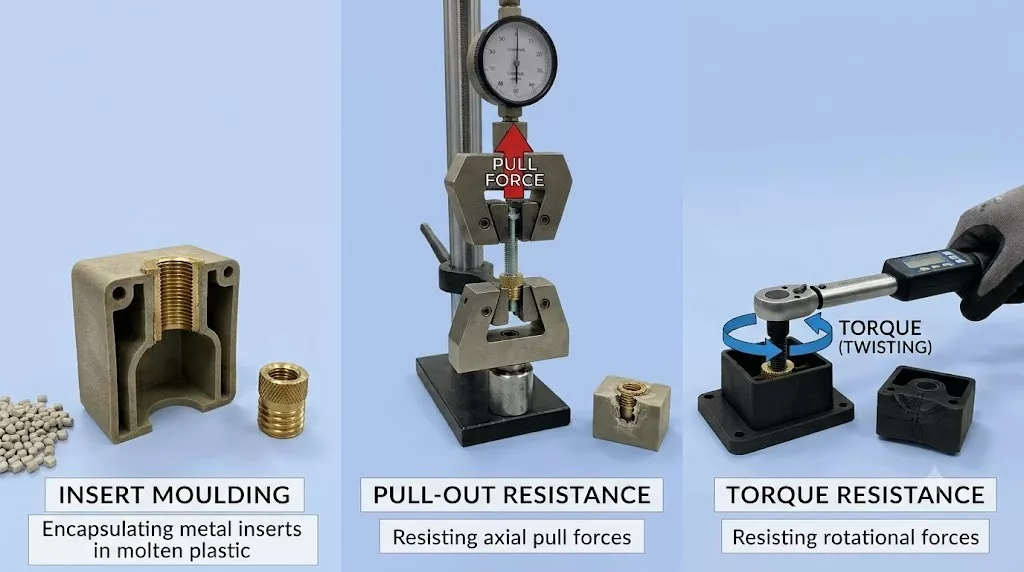
Insert moulding holds a metal part in plastic by mechanical grip, and two loads test that grip. Pull-out acts along the axis of the insert, and torque acts around it. How well the joint holds up under each depends on the insert, the plastic around it and the resin.
The two loads need different features, because the feature that stops an insert spinning is not the feature that stops it pulling out. An insert can resist one well and the other poorly, and both only count if the plastic around the insert does not crack.
Need a first production batch?
What Is Insert Moulding?
Insert moulding is a process in which a pre-made metal part, commonly a brass or steel bush, pin or terminal, is placed in the open mould before plastic is injected around it. The plastic cools and locks the insert in place.
The hold is mechanical, not adhesive. It comes from plastic flowing into the knurls, grooves and flats on the insert, and from the plastic shrinking onto it as it cools.
What Is Pull-Out Resistance?
Pull-out resistance is the axial force needed to pull the insert out of the plastic. It is measured in a tensile test and reported in newtons. Failure happens when the plastic shears at the insert surface or the insert slides free.
Grooves and undercuts give the plastic something to bear against, and the plastic trapped in them must be enough to carry the service load. Pull-out depends mainly on embedded length, so a longer insert holds more. In service, pull-out is the load a screw puts on a threaded insert when it clamps a part down.
Need to select a material before tooling?
What Is Torque Resistance?
Torque resistance is the rotational force needed to turn the insert in the plastic. It is measured in a torque test and reported in newton metres. Failure happens when the insert turns, or when the boss cracks under the load.
Knurls and flats lock the insert against rotation, and the knurled band must engage enough plastic to carry the installation torque. Torque resistance depends mainly on insert diameter. In service, torque is the load applied when a screw is tightened into the insert or a nut is turned onto it.
What Is the Difference Between Pull-Out and Torque Resistance?
The simplest distinction is direction. Pull-out acts along the axis of the insert, and torque acts around it. Each needs its own feature, and threaded inserts normally combine knurls for torque with a groove for pull-out. A smooth grooved insert resists pull-out but spins easily. A knurled insert with no groove resists rotation but can be pulled out.
| Load | What It Describes | Common Measurement | Feature That Resists It |
| Pull-out | Axial force along the insert | Newtons | Grooves, undercuts |
| Torque | Rotational force around the insert | Newton metres | Knurls, flats |
What Decides How Much Load an Insert Holds?
Geometry sets the holding strength. Embedded length mainly governs pull-out, diameter mainly governs torque, and the volume of plastic engaged by the knurls and grooves governs both. Every sharp corner on a knurl or groove is a stress riser in the surrounding plastic, so corners are radiused and the insert is kept free of machining marks and burrs.
The boss around the insert has to be thick enough to resist the stress from shrinkage and thin enough to avoid sink marks. An outer diameter of roughly 2 to 3 times the insert diameter is the usual range. Below about 2 times, the interference the plastic can carry is very small. Above about 3 times, a thicker wall adds little and invites sink. Ribs add strength to the boss without adding thickness.
The resin matters as much. Grip comes partly from the plastic shrinking onto the insert, so the shrinkage of the grade and its long-term strength both change the result. Plastic also splits around the insert and meets again behind it, and that weld line is weaker than the surrounding material. In glass-filled grades, design limits for weld lines can drop to about half of the published strength, so the weld line is kept away from the loaded boss, and Moldflow analysis at the design stage shows where it will fall.
Why Does the Plastic Around the Insert Crack?
As the plastic cools and shrinks, the metal insert restrains it. That restraint creates the grip, and it also leaves residual stress in the boss. If the stress is too high for the long-term loading the resin can carry, the boss cracks. Sharp corners on the insert, chemical exposure and sustained loads make it worse.
Because the stress is built in during moulding, a part can pass every test on the day it is made and still fail later. This is why pull-out and torque values only count when the boss around them survives.
How Does Insert Moulding Compare With Post-Moulding Insertion?
Insert moulding gives the best holding performance and is the route for high torque and pull-out loads. It is also the route for thermosets and highly filled plastics, where heat or ultrasonic insertion is not suitable. It adds loading time to every cycle and leaves residual stress around the insert that the design has to absorb.
Ultrasonic or heat insertion installs the insert into a moulded hole and melts only a thin layer of plastic, so far less residual stress is left behind. It is a common remedy when a moulded-in insert cracks a boss, and it can need only a small tool change. Retention depends on how well the insert is installed, so it is proven by testing.
Ready to move from validated design to first production batch?
How Is Holding Strength Proven?
Pull-out and torque are tested on moulded samples in the production-intent material, since a printed or cast part does not reproduce the grip or residual stress of a moulded one. Each test runs to failure and the result is compared against installation torque and service load with a safety margin. Samples are also tested in the conditions the product will see, and a held set is inspected again after a hold period for delayed cracks. Soft tooling, delivered in 2 to 6 weeks, gives moulded samples in production-intent material, so the joint can be tested before a production tool is committed.
How Marcopolo Supports Insert Moulded Parts
Insert moulding is part of our prototyping and tooling work. Brass inserts can be moulded in vacuum casting and RIM, and a soft-tooled set of connectors and sensors with insert moulding, 21 parts, was developed in 3 weeks. Our in-house design team runs DFM review and Moldflow analysis to avoid product failures and late-stage tooling errors. Soft tooling, delivered in 2 to 6 weeks in production-intent material, gives functional parts to test in real-world conditions before a production tool is committed. Parts are made under an ISO 9001 certified quality management system, with inspection on CMM and VMM measuring machines. Concept to production.
Planning a part with metal inserts?
FAQs
What is the difference between pull-out and torque-out?
Pull-out is the axial force needed to pull the insert out of the plastic. Torque-out is the rotational force needed to turn it. They are tested separately and resisted by different features.
Why do plastic bosses crack around inserts?
The insert restrains the plastic as it shrinks, which leaves residual stress in the boss. Sharp corners on the insert, chemical exposure and sustained loads raise that stress.
Can inserts be added after moulding?
Yes. Ultrasonic or heat insertion installs the insert into a moulded hole and melts only a thin layer of plastic, so far less residual stress is left behind. It is not suited to thermosets.