
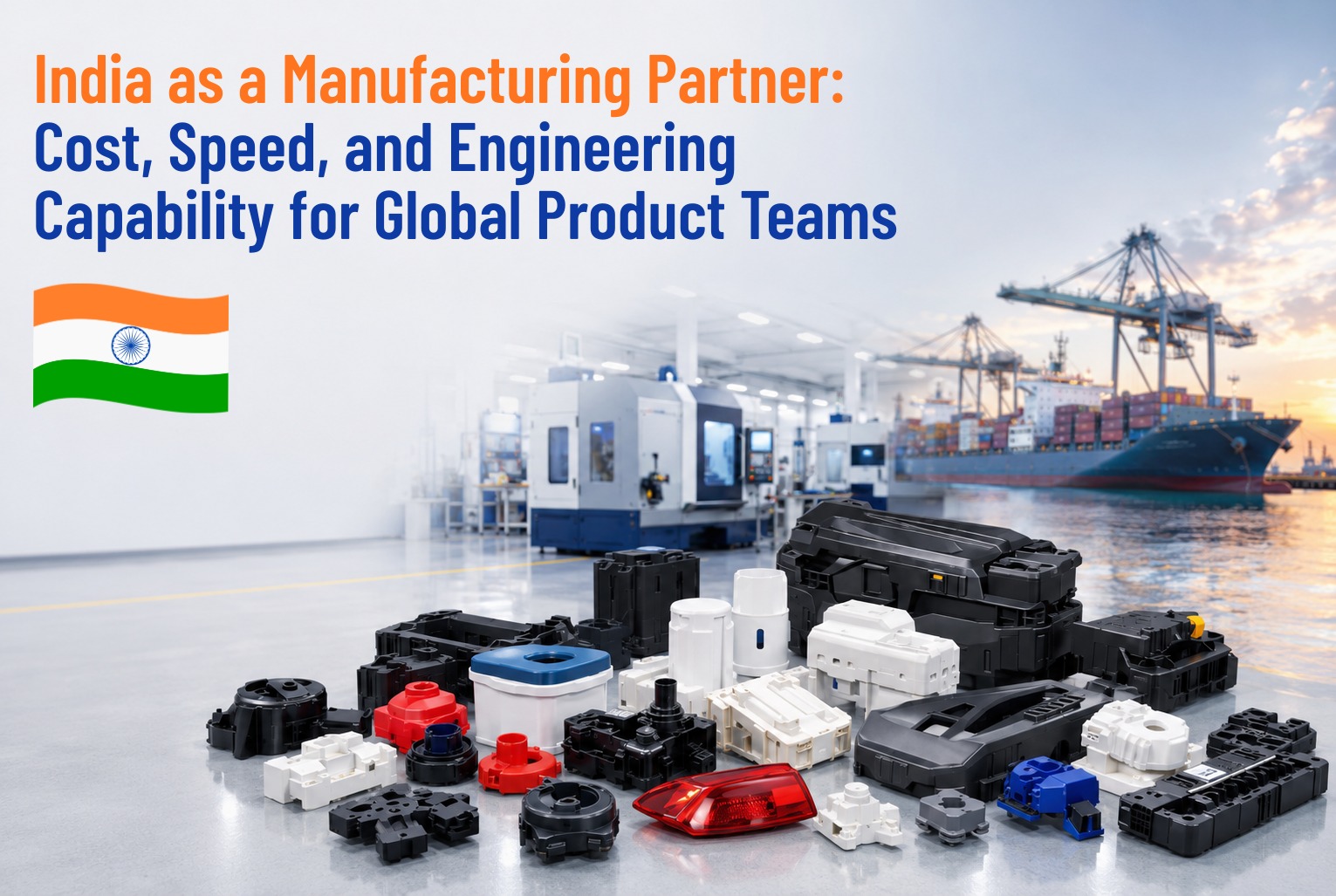
Global product teams have been sourcing from India for decades. What has changed is why.
The early logic was simple: lower labour costs, acceptable quality, manageable risk. That logic still holds, but it no longer captures the full picture. The teams choosing India today, for plastics development, prototyping, tooling, and component manufacturing, are doing so for reasons that go beyond cost. They are choosing India because the engineering capability, the supplier ecosystem, and the practical advantages of working with an Indian partner have reached a level that makes the decision strategically sound, not just economically convenient.
And the structural signals are accelerating that shift. Government investment in domestic manufacturing infrastructure across electronics, medical devices, and automotive components. Global companies restructuring supply chains away from single-country dependence and finding India consistently at the top of the shortlist. MedTech companies establishing R&D centres. Semiconductor manufacturers making long-term bets on Indian engineering talent. The territory is becoming visible to everyone. The manufacturing infrastructure to serve it has been building quietly for two decades.
Here is the honest case for India as a manufacturing partner for global product teams.
The cost advantage is real and it goes beyond labour
Manufacturing wages in India are significantly lower than in Western markets and roughly a half of equivalent Chinese rates. For tooling and injection moulding programs specifically, this translates into soft tooling and production tooling costs that are meaningfully lower than what the same quality of work would cost in Germany, the US, the UK, or Japan.
But the cost advantage in Indian manufacturing is not only about labour. Overhead costs, facilities, utilities, and engineering support are all significantly lower. A DFM review, a Moldflow simulation, and a full tool design package delivered by an in-house Indian engineering team costs a fraction of what an equivalent engagement would cost at a European or North American toolroom. The engineering quality is comparable. The cost structure is not.
For global product teams managing development budgets, this means more iterations, more validation builds, and more design confidence for the same investment.
The engineering capability argument is no longer marginal
Engineering R&D centres in India are expanding faster than any other segment of the global capability ecosystem, with automotive, industrial, and semiconductor companies building deep engineering capability in India that feeds directly into global product development pipelines.
This is not a future trend. It is already the operating reality for companies like Ford, Renault Nissan, Siemens, Honeywell, and dozens of others that have built or expanded engineering operations in India over the past decade.
For plastics manufacturing specifically, the engineering depth available spans DFM, Moldflow analysis, mould design, part design, material selection, and process engineering. The teams doing this work have run hundreds of programs across automotive, medical devices, electronics, and industrial equipment. When a global product team engages a well-established Indian manufacturer, the engineering review they receive is substantive, specific, and actionable. That level of engagement is not guaranteed everywhere, but in manufacturers with genuine program history, it is the standard.
The supplier ecosystem supports a one-stop model
One of the consistent challenges for global product teams sourcing internationally is vendor fragmentation. One supplier for prototyping, another for tooling, a third for production, a fourth for post-moulding operations. The coordination overhead adds weeks to programs and creates handoff risks that are entirely avoidable.
India’s manufacturing ecosystem, particularly in its established industrial hubs, has matured into something that supports genuine integration. Prototyping, tooling, injection moulding, finishing, assembly, quality inspection, and export logistics can all be managed through a single Indian manufacturing partner, such as Marcopolo Products, with the right in-house capability and supplier network. For global teams, this means one point of contact, one quality system, one set of engineering drawings, and one accountable partner from first prototype to production-ready component.
The practical advantages matter more than they get credit for
Three things about working with an Indian manufacturing partner that experienced global teams reference consistently but that rarely appear in formal supplier evaluations.
- Language: English is the working language of Indian engineering and business. Specs, drawing reviews, DFM reports, and commercial discussions all happen in English, without translation overhead or interpreter ambiguity.
- Time zone: The time zone works better than most teams expect for European clients. India Standard Time sits four and a half hours ahead of Central European Time in winter. A morning meeting in Germany, the Netherlands, or the UK is a mid-afternoon conversation in India. Same-day design review cycles are operationally practical in a way they are not with East Asian manufacturing partners where the working day overlap is minimal.
- Currency: The exchange rate consistently favours clients paying in USD, EUR, or GBP. Indian rupee pricing for tooling and manufacturing programs means that currency movement over a program’s lifetime has historically worked in the international client’s favour.
What this means for global product teams evaluating India right now
The question is no longer whether India can deliver. The evidence is in programs already running across every major industry. These are not aspirational case studies. They are the operating reality of the Indian manufacturing base today.
The question is which partner to work with. The right one has demonstrated program experience in your industry, engineering capability that engages with your design rather than just executing it, and the maturity to manage a program across time zones without constant chasing.
As global product teams continue navigating cost pressures, supply chain resilience requirements, and the constant need for speed and flexibility, partnerships with capable Indian manufacturers will play an increasingly central role in competitive product development. Marcopolo Products Pvt. Ltd. is one such partner, with over 25+ years of manufacturing plastic components for global clients across automotive, medical devices, electronics, and industrial equipment.
FAQs
Why are global product teams choosing India?
They are choosing India for a mix of cost efficiency, engineering support, production flexibility, and access to a broader supplier ecosystem.
Can India support low-volume and pilot production?
Yes. India is well suited for pilot builds, prototype-to-production transitions, and controlled batch production when the partner has integrated capabilities.
Why is prototype-to-production support important for overseas teams?
It reduces vendor handoffs, shortens feedback loops, improves engineering coordination, and lowers the risk of late-stage manufacturing issues.
What should buyers check before selecting a manufacturing partner in India?
They should review engineering support, quality systems, tooling capability, inspection infrastructure, export readiness, and experience with similar products.
Is India only a low-cost manufacturing option?
No. The value increasingly comes from engineering capability, faster development support, and integrated prototype-to-production execution, not just labour savings.
Why are global product teams increasingly evaluating India beyond cost alone?
Because engineering R&D capability in India has expanded significantly, with companies building deep design and development operations there, not just labour-cost arbitrage.