
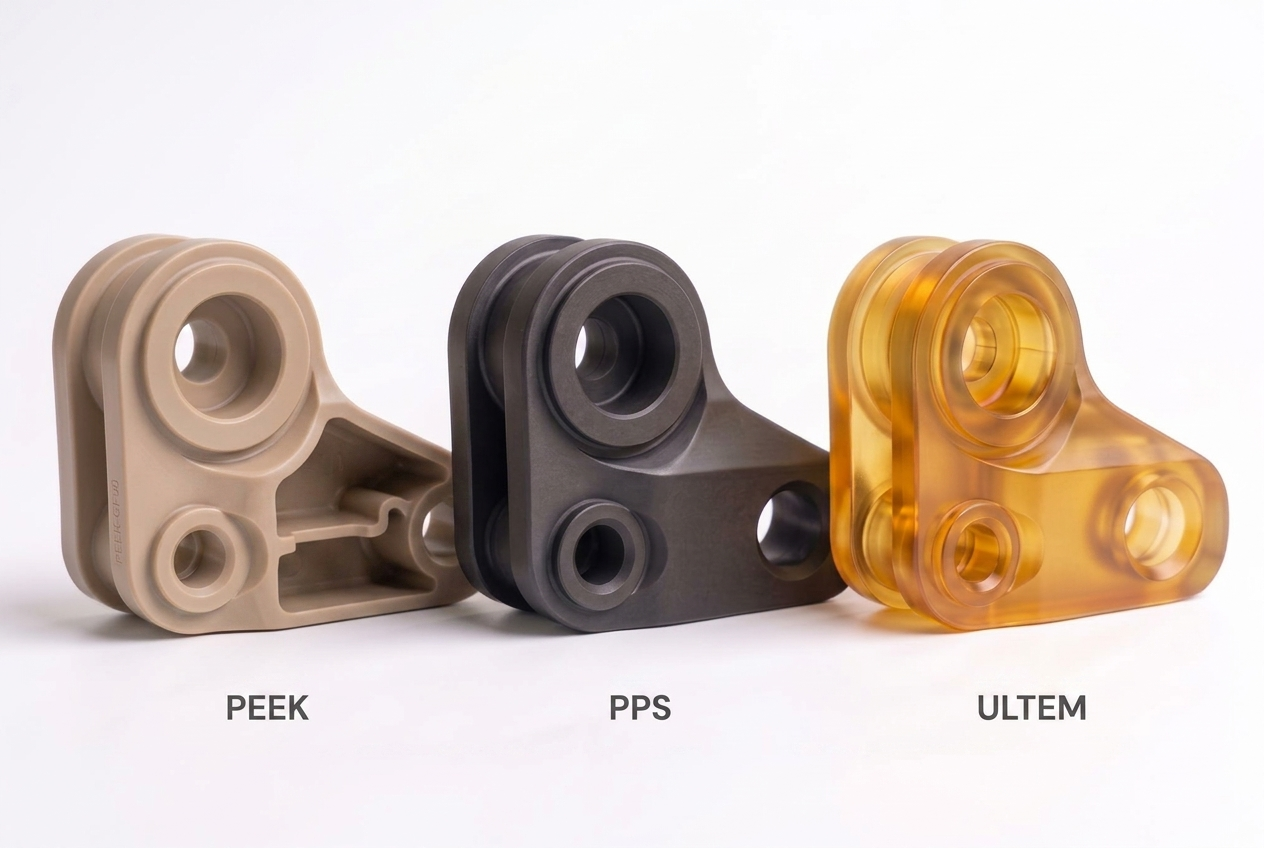
Standard engineering plastics work well within defined limits. But industrial parts exposed to high heat, chemicals, repeated loads, steam, electrical stress, or tight tolerances may need more capable materials. That is where high performance polymers in India become important.
PEEK, PPS, and ULTEM™ (PEI) are advanced engineering plastics used for demanding industrial parts. They can provide stronger thermal, chemical, electrical, dimensional, or mechanical performance than general-purpose materials such as ABS, PP, or conventional nylon. The right choice, however, depends on the exact grade, application, geometry, production process, and validation requirement.
Marcopolo moulds high performance plastics, including PEEK, ULTEM, and PPS, for thermal, structural, and chemically exposed applications in sectors such as medical, and EV.
Need help choosing a material?
What makes a polymer high performance?
A high performance polymer is selected because it retains useful properties in conditions where standard plastics may soften, creep, absorb moisture, crack, or lose dimensional stability. The material selection must start with the operating environment, not simply with a preferred resin name.
|
Application requirement |
What to assess |
| High service temperature | Continuous and peak-temperature exposure |
| Chemical contact | Compatibility with fluids, solvents, fuels, or cleaning agents |
| Structural load | Stiffness, creep, fatigue, and impact performance |
| Electrical use | Insulation, dielectric, ESD, and flame requirements |
| Tight tolerances | Shrinkage, warpage, moisture absorption, and process control |
| Regulated application |
Grade-specific documentation, testing, and traceability |
High performance plastics cost more than standard polymers, so the goal is not to use the most expensive material. It is to choose the lowest-risk, cost-effective grade that meets the full functional requirement.
PEEK for maximum thermal and mechanical performance
PEEK, or polyether ether ketone, is a semi-crystalline polymer used in demanding thermal, chemical, mechanical, and wear applications. It is often considered for components that must operate under sustained heat, chemical exposure, steam, repeated loading, or friction.
PEEK is available in unfilled, glass-filled, carbon-filled, and wear-modified grades. Each grade can behave differently in stiffness, shrinkage, wear, processing, and dimensional stability.
Typical industrial uses include high-temperature connectors, chemical-process components, precision structural parts, wear components, semiconductor equipment parts, and selected medical-device components.
PEEK requires controlled drying, mould temperature, cooling, tooling, and process validation. For injection moulding, DFM should review wall thickness, gate location, ejection, transitions, fiber orientation where applicable, and tolerance expectations before the tool is built.
Planning a PEEK part?
PPS for chemical resistance and dimensional stability
PPS, or polyphenylene sulfide, is often selected when chemical resistance, low moisture absorption, dimensional stability, and performance at elevated temperature are important. Reinforced PPS grades can add stiffness and strength for precision housings, fluid-handling parts, electrical components, and industrial brackets.
PPS is commonly considered for electrical connectors, pump and valve components, automotive under-hood applications, chemical-processing parts, and components exposed to humidity or aggressive fluids.
For PPS injection moulding, the filler system, gate position, cooling balance, wall thickness, and tolerance stack-up need careful attention. Glass-filled grades can improve stiffness but may affect surface appearance, tool wear, shrinkage, and directional behavior.
ULTEM for electrical and flame-performance needs
ULTEM™ is SABIC’s branded family of PEI materials. In suitable grades, it is known for electrical insulation, dimensional stability, flame performance, and useful strength at elevated temperature.
ULTEM can be a strong option for electrical housings, connectors, industrial equipment, components, medical equipment housings, and high-temperature fixtures. The exact grade matters: some are reinforced, some are transparent, and others are designed for specific flame, process, or compliance requirements.
Like other engineering materials, ULTEM needs appropriate drying, moulding conditions, draft, wall thickness, and surface-finish planning. Confirm chemical compatibility and grade-specific documentation for demanding industrial use.
PEEK vs PPS vs ULTEM
These materials are not interchangeable. Use the comparison below as an initial screening guide, then validate the final grade using the manufacturer’s technical data and application testing.
| Selection factor | PEEK | PPS | ULTEM™ (PEI) |
| Primary strength | High thermal, mechanical, and wear performance | Chemical resistance and dimensional stability | Electrical insulation and flame-performance options |
| Chemical resistance | Excellent in many demanding applications | Excellent | Grade and chemical dependent |
| Dimensional stability | High-grade and process-dependent | Very high | High |
| Electrical performance | Good | Good to excellent | Excellent in suitable grades |
| Relative cost | Typically highest | Moderate to high | High |
| Typical industrial use | Extreme heat, wear, chemicals, structural loads | Fluids, connectors, chemical environments | Electrical, flame, and structural components |
A comparison of PEEK and ULTEM also shows meaningful differences in elevated-temperature behaviour, electrical properties, chemical resistance, wear, and cost.
How to select the right polymer
Start with the application requirements:
- Define continuous and peak operating temperature.
- List chemical, steam, cleaning agent, and environmental exposure.
- Identify static, impact, fatigue, wear, or creep loads.
- Confirm electrical, ESD, flame, or insulation requirements.
- Check regulatory, medical, or customer specifications.
- Define volume, manufacturing process, tolerance, and finish.
- Specify inspection, material certificates, and traceability needs.
The material callout should be linked to the process. A correct resin in a poorly designed tool or an uncontrolled process can still result in unstable parts.
Manufacturing high performance parts in India
For high performance polymers in India, material availability is only one part of the decision. A manufacturing partner must also be able to review the CAD model, process the selected grade, design appropriate tooling, control critical moulding conditions, and inspect the finished part.
Marcopolo’s injection moulding service supports PEEK, ULTEM, PPS, engineering plastics, low-MOQ production from 50 parts, post-moulding operations, and ISO 9001 quality management with CMM/VMM inspection.
For defense programs, Marcopolo identifies high-performance plastics and low-volume component manufacturing as relevant capabilities. For medical-device projects, material suitability must always be confirmed against the exact grade, application, sterilisation method, and regulatory requirement.
Have a demanding industrial application?
Common mistakes to avoid
Avoid selecting material only by maximum temperature rating, using a generic PEEK/PPS/ULTEM label without a grade, ignoring chemical compatibility, designing like the part is made from ABS, or skipping DFM before tooling.
Also avoid assuming that a prototype material is equivalent to the final production grade. For critical components, verify material certification, inspection requirements, process records, and functional testing before approval.
Conclusion
PEEK, PPS, and ULTEM are valuable options for industrial components that need more than standard engineering plastics can provide. The best material is the one that meets the complete thermal, chemical, mechanical, electrical, regulatory, and cost requirement—not simply the highest-performing resin on paper.
When evaluating high performance polymers in India, assess grade selection, DFM, tooling, process control, inspection, and the manufacturer’s ability to support prototype-to-production development.
Ready to assess your material?
FAQs
What are high performance polymers?
They are advanced engineering plastics designed to retain useful mechanical, thermal, chemical, electrical, or dimensional properties in demanding applications.
Which high performance polymers are available in India?
PEEK, PPS, ULTEM™ (PEI), PPSU, and other specialised engineering polymers are available through Indian material and manufacturing supply chains.
Is PEEK better than PPS?
Not always. PEEK is often selected for maximum thermal, mechanical, wear, or chemical performance, while PPS can be a better fit for chemical resistance, dimensional stability, and cost balance.
Is ULTEM the same as PEI?
ULTEM™ is SABIC’s trademarked PEI resin family. PEI describes the polymer type; ULTEM refers to specific branded grades.
Can PEEK, PPS, and ULTEM be injection moulded?
Yes. Each can be injection moulded with the correct grade, drying, tool design, moulding window, and quality control.
Are high performance polymers suitable for industrial parts?
Yes, when the selected grade meets the actual temperature, chemical, load, electrical, and regulatory requirements of the part.
What is required for a material recommendation?
Provide CAD, 2D drawings, operating temperature, loads, chemical exposure, electrical requirements, compliance needs, target quantity, and expected process.