
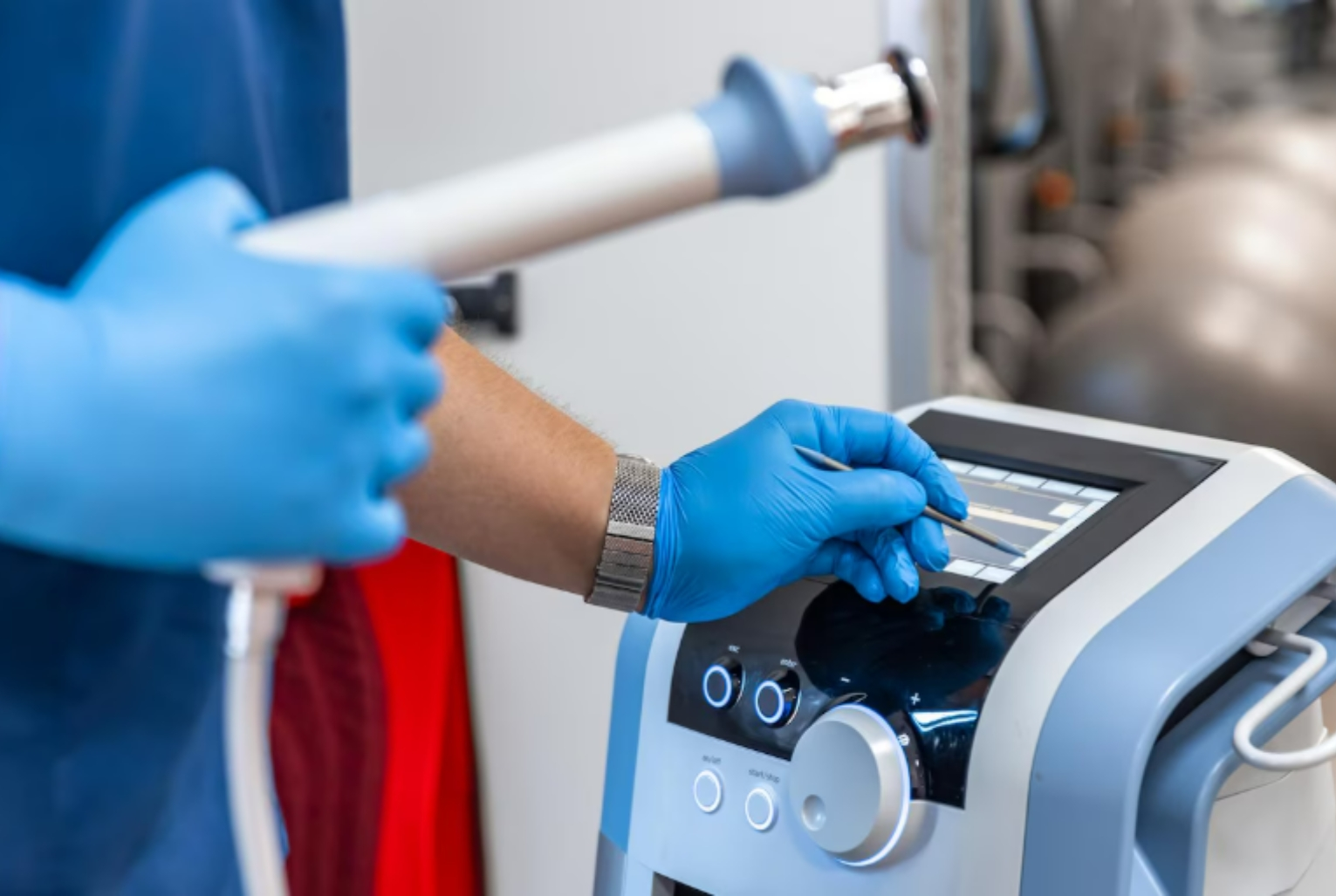
Most manufacturers are built for scale — large tooling investment, amortised over a high-volume run. That model works well for products that already exist at scale. Medical device innovation doesn‘t start there. It starts with a clinical validation build, a regulatory submission sample, a pilot batch that has to prove the design works before anyone commits to mass production — at quantities most commercial manufacturers won‘t quote seriously.
Low-volume production exists to close that gap. It isn‘t a smaller, cheaper version of mass production. It’s a manufacturing approach built specifically for this stage of the device lifecycle, where the part still has to meet the same standard the final device will be held to. We‘ve covered low-volume manufacturing for medical device industry before — this post goes one level deeper, into how the right process and the right documentation come together at each stage.
From prototype to low-volume production?
Matching Manufacturing Process to Development Stage
Every stage of a medical device program asks a different question of the part. The table below maps the process to the question it’s actually answering.
| Stage | Process | Materials | Volume / Lead Time | Answers the Question |
|---|---|---|---|---|
| Design Validation | 3D Printing (SLA, SLS, MJF) | ABS-like, PC-like, Nylon, Glass-Filled | 1–3 days | Does the geometry, fitment, and feature accuracy work? |
| Functional & Clinical Validation | Vacuum Casting & RIM | Production-equivalent polyurethane, biocompatible grades | 10–100 parts/batch | How will surface finish, strength, and heat performance behave? |
| Regulatory Submission & Pilot Batches | Soft Tooling | Biocompatible PC, ULTEM, TPU, PPSU | 100–5,000 parts; 2–6 weeks | Are the parts dimensionally and materially production-real? |
| Series Production | Production Tooling | Same production-intent polymers | Hundreds of thousands of shots; 5–8 weeks | Is the program ready to scale? |
3D Printing — Design Validation. Prototypes are typically ready in 1 to 3 days, answering early questions about geometry, fitment, and complex feature accuracy across ABS–like, PC–like, Nylon, and Glass-Filled materials.
Vacuum Casting and RIM — Functional and Clinical Validation. Production–equivalent polyurethane grades, including biocompatible options, typically cover 10 to 100 parts per batch. RIM handles large device covers and housings — up to 2m in a single piece — without committing to hard tooling. This is the stage where surface finish, strength, and heat performance start to give a realistic read on how the final device will behave.
Soft Tooling — Regulatory Submission Samples and Pilot Batches. Exact production–intent biocompatible polymers — PC, ULTEM, TPU, PPSU — at 100 to 5,000 parts per program, with 2 to 6 weeks tooling lead time. Because the tool is built in aluminium or unhardened steel rather than hardened production steel, tooling investment runs roughly 50% lower than a production tool, while the parts themselves are dimensionally and materially the real thing. (We go deeper on how soft tooling delivers true engineering–grade parts in our soft tooling guide.)
Production Tooling — Series Production. 5 to 8 weeks tooling lead time, supporting runs into the hundreds of thousands of shots, once the program is validated and ready to scale. Same facility, same engineering team, same documentation trail carried forward from every stage before it — no vendor change and no re-qualification cycle at the point a program needs to scale.
What Low Volume Injection Molding Actually Delivers
Quality requirements don‘t relax because the batch is small. If anything, documentation matters more at low volume, because regulatory submissions depend on traceability that a mass-production batch can sometimes take for granted.
In practice, that means:
- Material certificates and Certificates of Analysis for every batch of biocompatible polymer used
- CMM and VMM dimensional inspection against the engineering drawing
- First Article Inspection on the first part of any new tool
- Sample Inspection Reports or Pre–Dispatch Inspection documentation before parts ship
- In–house DFM review and Moldflow simulation before tooling starts — not after
A design issue caught in DFM review costs nothing. The same issue caught after a soft tool is cut costs the tool, the timeline, and in a regulated program, potentially a re-submission. This is also where a manufacturing partner’s own quality system matters — our facilities and quality control are built around exactly this kind of traceability.
Get full traceability and documentation for your validation batch.
Materials That Match the Application
| Material | Typical Use | Notes |
|---|---|---|
| Biocompatible PC, ULTEM, TPU, PPSU | Rigid housings, structural components, over-moulded assemblies | Covers most regulatory submission and pilot-batch needs |
| PP/PC over-moulded with TPU | Soft-touch grips, sealing medical-grade surfaces on rigid housings | Adhesion between materials is validated during the soft-tooling stage, not assumed |
What This Looks Like in Practice
- A soft tool built to validate a surgical robot component’s design, in biocompatible PC with ultrasonic-welded assembly, can go on to supply production volumes for years before a production tool investment is even justified — the validation tool becoming the production solution, not a step that gets discarded once volumes grow.
- A new cannula design can move from concept to soft-tooled prototype in around three weeks when material, process, and DFM review are aligned from the start.
- Large device covers, difficult to justify in hard tooling at low quantities, run reliably through RIM at a steady monthly cadence with consistent finish quality.
None of these outcomes depended on treating a small batch as a lesser version of production. They depended on a manufacturing partner built to take that volume seriously in the first place — not adapted for it as an exception, but designed for it from the start.
Why Manufacturers Choose Marcopolo for Medical Device Programs
- 25+ years of tooling and moulding experience
- 1,400+ tools developed across automotive, medical, electronics, and industrial sectors
- In-house DFM and Moldflow review before tooling starts — no external handoffs
- One partner, every stage — from 3D-printed validation builds through soft tooling to series production, with no vendor change and no re-qualification cycle
- Full documentation trail — material certificates, FAI, CMM/VMM inspection, and Sample Inspection Reports carried through every stage
Our Capabilities for Low-Volume Medical Device Production
| Stage | Service |
|---|---|
| Design Validation | 3D Printing — SLA, SLS, MJF |
| Functional Validation | Vacuum Casting & RIM |
| Regulatory Pilot Batches | Soft & Production Tooling |
| Series Production | Injection Moulding |
| Industry Focus | Medical Devices Manufacturing |
Share your component requirements, target stage, and material specification. Our engineering team will recommend the right process, flag any DFM concerns before tooling starts, and provide a fixed-price quotation with a clear scope and timeline.
One partner from validation build to series production — no vendor change at any stage, and no quantity too small to take seriously.
Get Your Validation Stage Right From the Start
FAQs
What is low-volume production for medical devices?
It’s a manufacturing approach for producing medical device components in small batches from a handful of clinical validation parts to a few thousand regulatory pilot-batch units using processes like 3D printing, vacuum casting, and soft tooling instead of committing to full production tooling.
Does compliance documentation change at low volume?
No — quality requirements stay the same regardless of batch size. Material certificates, dimensional inspection, First Article Inspection, and Sample Inspection Reports are still required, and they matter more at low volume because regulatory submissions depend on that traceability.
What's the difference between soft tooling and production tooling for medical devices?
Soft tooling uses aluminium or unhardened steel and supports 100–5,000 parts at roughly 50% lower investment. Production tooling uses hardened steel for runs into the hundreds of thousands of shots. Both can use the same production–intent biocompatible material.
Which materials are biocompatible for medical device components?
Common biocompatible options include PC, ULTEM, TPU, and PPSU, along with medical–grade PP for sterilisation-sensitive components.
Can the same tool used for validation be used for production?
Yes. A soft tool built for a validation or pilot batch can often continue to supply production volumes for years, especially at moderate quantities, before a hardened production tool investment is justified.
How long does it take to go from design to a soft-tooled medical device prototype?
With DFM review, material selection, and tooling aligned from the start, a typical component can move from design freeze to soft-tooled parts in 2 to 6 weeks, depending on complexity.