
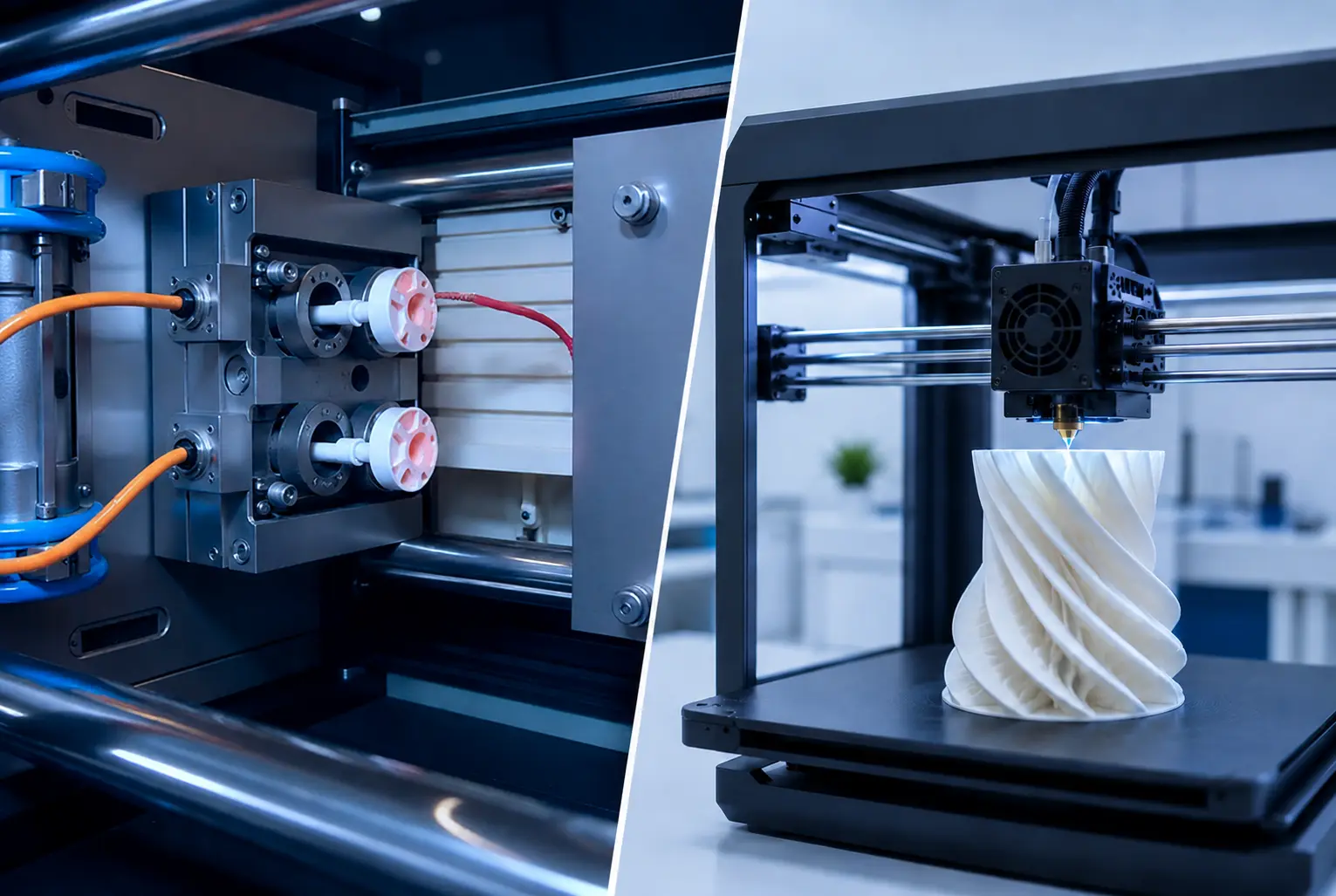
The question isn‘t which process is better. It’s which one matches the stage your part is actually at — and getting that wrong in either direction costs you something specific: too much time and money if you tool up too early, or unreliable data if you validate in the wrong material for too long.
This comparison breaks down where 3D printing earns its place, where low volume injection molding takes over, and the cost logic that decides which one you actually need.
Not sure which process fits your part?
What 3D Printing Actually Delivers
3D printing‘s advantage is zero tooling cost and fast turnaround, at the price of working in a material equivalent rather than the exact production polymer.
| Process | Material | Lead Time | Best For | Not Suited To |
|---|---|---|---|---|
| SLA | ABS-equivalent | Days | Visual, aesthetic and fitment validation | Functional stress testing, heat exposure and outdoor use |
| SLS / MJF | Nylon PA12 | 3–5 days | Complex geometry and functional screening for electronics or industrial components | Cosmetic display models and clear or transparent parts |
Across both technologies, the part you’re holding is an equivalent — close enough for form, fit, and a reasonable read on function, but not the polymer your production part will actually use, and not at the dimensional accuracy a moulded part can hold. (For a deeper breakdown of SLA vs SLS vs MJF, see our 3D printing process comparison.)
What Low Volume Injection Molding Actually Delivers
Soft tooling — aluminium or pre-hardened steel (EN31, P20) — moves you into the actual production polymer: ABS, PC, PP, PA6, PA66, POM, PC-ABS, PPS, PSU, PEEK, ULTEM, glass-filled variants up to 60%, FR-rated and UV-stabilised grades, with TPE/TPU over-moulding where the design calls for it.
- Dimensional accuracy: ±0.02 to 0.05mm — an order of magnitude tighter than any 3D printing process, with surface finish consistent, textured, or polished as specified
- Tool lead time: 2 to 6 weeks
- Economical quantity range: roughly 50 to 5,000 parts per program
- Tooling investment: around 50% lower than hardened production tooling
Below that quantity floor, tool cost dominates the per-part economics and 3D printing remains the better call. Above it, low volume injection molding through soft tooling takes over. (We cover the materials side of this in more depth in why soft tooling is the best option for functional prototypes.)
Not sure which process fits your part?
Process Comparison: 3D Printing vs. Low Volume Injection Moulding
| Factor | 3D Printing | Low-Volume Injection Molding |
|---|---|---|
| Tooling cost | None | Real investment, ~50% lower than production tooling |
| Per-part cost | Higher | Lower, drops sharply with volume |
| Lead time | Days | 2–6 weeks |
| Dimensional accuracy | Standard, process-dependent | ±0.02 to 0.05 mm |
| Material | Equivalent (resin or PA12) | Actual production polymer |
| Economical quantity | 1–50 parts | 50–5,000 parts |
3D printing carries no tooling cost and a higher per-part cost. Soft tooling carries a real tooling investment and a much lower per-part cost. As quantity rises, the soft tooling economics overtake 3D printing — exactly where that crossover sits depends on part size, geometry complexity, and material, so it’s worth quoting both ways before committing rather than assuming either process by default.
The Quality Question Is Really a Material Question
The accuracy gap between 3D printing and soft tooling matters less in isolation than what it represents: whether the part you’re testing is made of the actual material the final product will use. A geometry check doesn‘t need exact material properties. A functional test that’s about to inform a regulatory submission, a thermal validation, or a fatigue assessment does and a material equivalent printed in resin or PA12 won‘t give you trustworthy data for that, no matter how tight the dimensional tolerance reads.
Matching Process to What You're Actually Deciding
| If the question is… | Use This Process |
|---|---|
| “Does this fit, does this look right, can we hold a meeting around it?” | 3D Printing — almost always SLA for speed, unless geometry needs SLS or MJF’s mechanical realism |
| “Does this part behave the way the production part will, in the material it will actually be made from?” | Soft Tooling — even at quantities as low as 50–100 parts, because the answer only counts if the material is real |
| “Has the program moved past validation into stable, repeatable volume?” | Production Tooling — its own lead time and investment profile, outside the scope of this comparison |
Find the right process for your part.
Why Manufacturers Choose Marcopolo
- 25+ years of experience.
- 1,400+ tools delivered.
- In-house DFM and Moldflow Analysis.
- Prototype to production under one roof.
Share your CAD file, target quantity, and material requirement. Our engineering team will recommend the right process — 3D printing, soft tooling, or a combination across stages — with a fixed-price quotation and any DFM considerations flagged before you commit to tooling.
Not Sure Which Process Fits Your Stage?
FAQs
What is low volume injection molding?
It’s injection moulding done with soft tooling — aluminium or pre–hardened steel moulds— instead of production steel. It produces parts in the actual production polymer at quantities from roughly 50 to 5,000, with 2–6 week lead times and about 50% lower tooling investment than a production tool.
Is 3D printing cheaper than low volume injection molding?
At very low quantities (roughly 1–50 parts), yes — 3D printing has no tooling cost. Past that range, soft tooling‘s lower per-part cost overtakes 3D printing‘s per-part cost, and the crossover point depends on part size, geometry, and material.
Can 3D printed parts be used for functional testing?
SLS and MJF nylon parts can support functional screening, especially for complex geometry. But for tests that inform regulatory submissions, thermal validation, or fatigue assessments, only the actual production polymer — delivered through soft tooling — gives trustworthy data.
How accurate is low volume injection molding compared to 3D printing?
Soft-tooled injection moulded parts typically hold ±0.02 to 0.05mm, roughly an order of magnitude tighter than standard 3D printing tolerances.
What materials can I get with low volume injection molding?
ABS, PC, PP, PA6, PA66, POM, PC–ABS, PPS, PSU, PEEK, ULTEM, glass-filled variants up to 60%, FR-rated and UV-stabilised grades, and TPE/TPU over-moulding — the same polymers used in full production.
How long does low volume injection molding take?
Soft tool lead time runs 2 to 6 weeks from design freeze, including DFM review and tool machining, compared to days for 3D printing and 8+ weeks for hardened production tooling.