
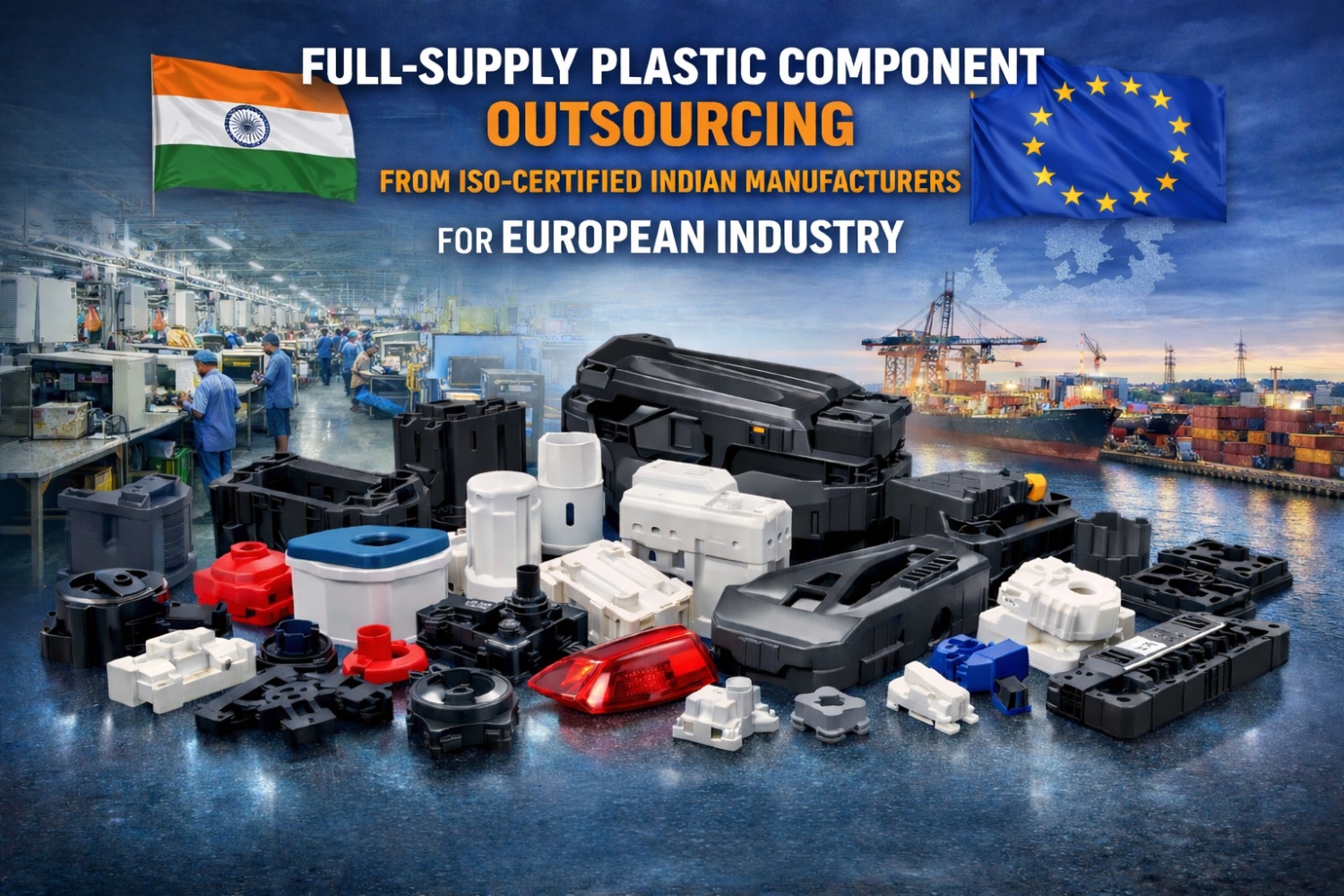
Plastic Component Outsourcing India is becoming increasingly attractive to European OEMs as the India-EU FTA deal 2026 is applied. A growing number of European OEMs are expected to look for full-supply partnerships with ISO-certified manufacturing facilities in India. While the Free Trade Agreement is instrumental in driving this shift, it is not the only factor behind this changing trend.
European industrial companies face a persistent challenge: managing fragmented supplier networks for plastic components. A control panel assembly might source housings from one supplier, mounting brackets from another, cable management clips from a third, and internal structural parts from yet another vendor.
A growing number of European OEMs are consolidating this complexity through full-supply partnerships. After the bilateral trade deal between India and EU, Indian facilities can emerge as ideal for the said purpose.
The full-supply model transforms supply chain economics. European companies eliminate the administrative burden of managing multiple vendors while gaining production flexibility.
The Full-Supply Model: Beyond Individual Part Sourcing
Earlier, European OEMs were focused on high-volume product manufacturing while outsourcing plastic components to India or other countries in Asia and Europe. They considered that only the cost arbitrage of large-scale production justifies the cross-continent coordination effort.
The OEMs used to identify their highest-volume parts, then negotiate tooling and piece prices. At last, they used to agree on the import logistics for those specific items. But the full-supply model operates differently.
For European OEMs, this integration removes the excess burden of coordinating between multiple specialists.
Instead of cherry-picking individual parts, European OEMs transfer responsibility for entire component categories, which includes all plastic parts for a product family, complete enclosure systems for industrial equipment, or the full range of structural and cosmetic components for a machine platform.
This comprehensive approach works because capable European OEM manufacturing partners in India. Their facilities have developed integrated capabilities spanning the complete manufacturing chain.
Indian contract manufacturers, such as Marcopolo Products, have all project capabilities under one roof: tooling design and fabrication, injection moulding across multiple machine tonnages, CNC machining for hybrid metal-plastic assemblies, secondary operations including welding and printing, final assembly, quality verification, and logistics coordination.
Thus, a single point of contact manages the complete component supply, simplifying both new product launches and modification of existing products of the OEMs.
Managing Complete Plastic Component Portfolios
Industrial products are rarely standalone items; they are integrated systems of components that must function, assemble, and look like a cohesive whole.
Consider a professional electrical enclosure, which requires a base, cover, mounting rails, grommets, and clips, or a fluid handling module assembled from reservoirs, housings, manifolds, and fittings.
Indian manufacturers offering plastic contract manufacturing for Europe increasingly support complete component portfolios, including:
- Structural and cosmetic parts
- Functional housings and enclosures
- Multi-variant and family-based components
- Components spanning different product generations
The Integrated Advantage
Consolidating your portfolio with one partner transforms the development process:
1. Coordinated Design & Material Strategy
A unified engineering team reviews the entire system, identifying assembly conflicts and opportunities for part consolidation early. This enables strategic material selection, potentially standardizing on fewer polymer grades to meet all functional needs while simplifying inventory.
2. Optimized Tooling Economics
Investment shifts from a series of individual tool costs to a strategic, portfolio-wide optimization. This can involve designing family molds to produce multiple parts in one cycle or planning a phased tooling build to align with your budget and production timeline.
3. Simplified Quality Management
Instead of reconciling disparate reports from multiple suppliers, you receive a consolidated quality dossier for the entire build. This provides a single source of truth for dimensional data, material certifications, and assembly validation, ensuring consistency across every component.
This portfolio-level view is a key reason European OEMs and their manufacturing partners from India increasingly favor integrated sourcing relationships.
Single-Partner Sourcing and the Reduction of Supplier Fragmentation
The technical complexity of industrial component production India operations becomes most apparent when managing complete component portfolios.
Imagine a product with fifteen plastic parts, from a 1.5kg structural housing down to a 3-gram precision clip. Each requires different machine tonnages, cycle times, inspection protocols, and materials. Managing this portfolio across separate vendors risks logistical chaos.
A full-supply contract manufacturing partner synchronizes these variables into a cohesive workflow, delivering assembly-ready kits instead of a pile of disparate parts.
Synchronized Production & Strategic Maintenance
Production Planning: We schedule moulding runs to align component availability, preventing the costly scenario where 13 parts are in stock, waiting for 2 delayed components.
Tool Maintenance: Maintenance is scheduled strategically during planned production gaps to avoid unexpected failures that halt entire assembly lines.
Single-Partner sourcing has a couple of nuanced benefits:
1. Streamlined Design Changes & Lifecycle Management
When a design change is required, such as modifying mating features on three interrelated parts, the manufacturing partner (like Marcopolo Products) manages the process internally.
This, otherwise, would have been difficult, because coordinating changes across three different manufacturing partners would have resulted in delays, miscommunication, and compatibility issues.
2. Integrated Post-Processing for Complete Assemblies
Components rarely ship as raw mouldings. They require secondary operations: ultrasonic welding, heat staking, pad printing, or final assembly into plug-and-play modules. In case of multiple suppliers, these operations can create exponential complexity.
Consolidating all post-processing with the moulding partner streamlines the workflow and provides single-point accountability for the complete functional assembly.
At Marcopolo Products, we coordinate tooling, moulding, and assembly operations under one roof.
Reducing Supplier Fragmentation Through Strategic Partnerships
Managing multiple suppliers incurs significant hidden costs that extend far beyond unit price differences. Each vendor relationship demands dedicated resources:
Procurement hours for Request-for-Quotes (RFQs) and Purchases Orders (POs)
Quality engineering time for audits and corrective actions
Logistics coordination for shipments, and accounts payable work for invoicing
For a European manufacturer sourcing from ten different plastic component suppliers, this administrative burden multiplies. A quality issue can trigger lengthy email chains across time zones to diagnose the root cause. While, a production delay at one vendor can idle an entire assembly line, creating costly bottlenecks.
The Strategic Alternative: Full-Supply Partnership
Plastic contract manufacturing for Europe through full-supply partnerships collapses this complexity.
- A single supplier relationship replaces multiple vendor interactions.
- One quality audit verifies ISO 9001 implementation across all components rather than requiring separate audits for each part supplier.
- Corrective action processes follow consistent protocols.
- Communication happens through established channels with known contacts rather than navigating different organizational structures for each supplier.
The risk profile changes as well.
This consolidation fundamentally changes the risk dynamic. Instead of being a minor client to several small suppliers, you become a strategically important partner to a single, capable manufacturer.
This fosters greater responsiveness and commitment to quality.
While this concentration of volume does require thorough due diligence and active relationship management, it replaces the diffuse risk of multiple unreliable vendors with manageable risk of one accountable partnership.
Handling Low to Medium Production Volumes with Flexibility
For European manufacturers, the economics of low-to-medium production runs often make domestic sourcing or single-part outsourcing impractical. This is where a strategic partnership with an Indian contract manufacturer creates decisive value.
Unlike mass-production facilities, contract manufacturing partners from India, like Marcopolo Products, are structured specifically for this segment. They are offering consistency without the pressure of high minimum order quantities.
The manufacturing partners are providing dedicated support for:
- Pilot and pre-series production
- Variant-heavy programs
- Region-specific product configurations
The Portfolio Model: Making Economies of Scope Work for You
The full-supply model becomes viable here through economies of scope. While the volume of any single part may be low, the total volume across your entire component portfolio justifies a dedicated partnership. This allows you to consolidate supply and gain operational simplicity, even for programs that would be uneconomical part-by-part.
Built-In Agility for Real-World Demand
Industrial demand is rarely static. It fluctuates based on seasonal patterns, project-based sales cycles, or market conditions.
Rather than forcing European OEMs to maintain high inventory levels to buffer demand uncertainty against rigid production schedules, precision injection moulding partners from India adjust production cadence.
Ultimately, this flexible, portfolio-based approach transforms low-volume production from a logistical challenge into a source of strategic supply chain resilience.
Supporting Ongoing Production and Product Lifecycle Management
While new product introductions command attention, the true measure of a manufacturing partnership is its performance across the product’s entire lifecycle.
This ongoing phase is where partnerships either solidify or slowly erode.
A full-supply relationship proves indispensable here. Products inevitably evolve: design refinements address field issues, cost initiatives simplify parts, and regulations mandate updates. Managing these “running changes” across multiple suppliers is a major coordination challenge, risking revision mismatches and assembly errors.
With a single, consolidated partner, this evolution happens internally. They coordinate, with their EU partners, the changes affecting multiple components for synchronized implementation and compatibility.
Tool modifications and quality validations also happen under one roof, following, of course, consistent protocols and familiar documentation.
For repeat orders, the process becomes streamlined and predictable. Instead of recurring RFQs and renegotiations, production continues based on established schedules and agreed terms.
Production Planning and Execution Support
OEMs choosing full-cycle EU manufacturing partners from India expect their operations to mesh seamlessly with European business needs.
This means understanding, for example, that a German automotive tier-one supplier operates differently from a Dutch industrial equipment manufacturer (even though both might source plastic components).
Similarly, planning has to account for the long lead time: 4-6 weeks by sea plus customs. A good partner works backwards from the required delivery date in Europe to schedule production, avoiding excessive buffer stock.
Execution visibility matters equally.
European OEMs expect transparency into production status. They want clarity on when tools enter production, current manufacturing progress, quality inspection results, and shipment tracking information.
It’s also important to understand that the modern teams from a developed European country will prefer this transparency and real-time updates from a dashboard (and not e-mail trails or messaging).
Finally, the injection moulding manufacturer from India must be capable of handling demand spikes.
A full-supply partner must maintain sufficient manufacturing capacity to handle volume peaks without compromising delivery commitments. This requires keeping spare machine capacity, flexible staffing, and strategic material stocks to ensure commitments are met even when volumes jump.
Post-Processing Integration: From Components to Assemblies
The real value of a full-service partner is in delivering finished and functional assemblies (not just individual components).
However, every extra step handled in the assembly separately adds a new level of complexity.
CNC machining Europe projects often illustrate the limitation.
For example, if a part needs precision CNC machining after moulding, it must be shipped to another vendor. This, in turn, creates delays, extra costs, and quality risks at each handoff.
A true full-supply partner eliminates these steps through integrated post-processing under one roof. In other words, machining, ultrasonic welding, pad printing, and final assembly with purchased hardware are all done in-house.
For European manufacturers, this integration simplifies everything:
- Assembly labor shifts to the manufacturing partner
- Quality is verified before shipment
- Packaging is optimized for modules, not individual components
The plastic component manufacturing (with assembly) outsourcing to India will ease a majority of the supply chain worries for the OEMs from the European Union nations.
The India-EU Trade and Regulatory Environment
The commercial viability of export manufacturing partnerships between India and the EU depends on more than manufacturing capability.
However, favorable trade conditions and regulatory alignment are equally critical.
Recent developments have significantly improved the environment for cross-border component supply.
India EU trade opportunities continue to expand as both regions recognize their mutual economic benefits. Ongoing negotiations around bilateral trade India EU agreements signal commitment to deeper integration. While comprehensive free trade agreements involve complex, multi-sector talks, targeted progress on manufacturing components continues steadily.
EU tariff cuts on Indian exports in specific categories have reduced the total delivered costs for European OEMs.
Combined with India’s structural cost advantages in tooling, skilled labor, and facility overhead, these tariff reductions strengthen the economic case for component outsourcing without compromising on quality or technical standards.
Regulatory harmonization between India and the EU has also advanced significantly.
Indian manufacturers exporting to Europe have built dedicated expertise in key EU regulations. This includes:
- RoHS compliance for electronic components,
- REACH requirements for chemical substances
- Machinery directive compliance for safety-critical parts.
This knowledge is reinforced by widespread ISO-certified manufacturing in India, where quality systems are aligned with European standards, greatly simplifying the supplier qualification process for EU buyers.
The progress has fueled a clear European industrial outsourcing trend to India, reflecting confidence in these developments.
Today, component outsourcing is no longer limited to high-volume consumer goods but confidently extends to medium-volume industrial applications, where technical requirements meet or exceed those of the consumer sector.
Contract Manufacturing Beyond Individual Deliverables
Sourcing plastic components as individual parts divides ownership across multiple suppliers. Tooling, molding, post-processing, and assembly are split between vendors. This division creates ongoing coordination costs and weakens control over the final product.
The full-supply contract manufacturing model solves this by managing complete programs instead of separate parts. The goal becomes sustaining stable production for the entire lifecycle of a product, not just delivering individual batches.
This model integrates tooling, production scheduling, post-processing, and assembly into one coordinated plan. It manages repeat orders and product revisions, rather than single purchase orders. For long-running European industrial products, this integration minimizes disruption and prevents variation.
A full-supply contract manufacturing partner in India is judged on consistency and reliable continuity, not only on production volume.
Individual-Part vs. Full-Supply Model
| Area | Individual Parts | Full-Supply Model |
|---|---|---|
| Responsibility | Limited to specific parts | Manages the complete component program |
| Supplier Setup | Multiple vendors | One accountable partner |
| Tooling Approach | Reactive, per batch | Planned for the product lifecycle |
| Production Planning | Driven by purchase orders | Driven by forecasts and repeat orders |
| Change Management | Handled as exceptions | Integrated into standard processes |
| OEM's Efforts | High coordination burden between individual vendors | Coordination burden with only one partner |
| Supply Risk | Dispersed and difficult to control | Consolidated and easier to manage |
For EU OEMs prioritizing reliability and long-term continuity, this model provides a more controlled and manageable approach to outsourcing plastic components. It turns a complex, multi-vendor process into a single, dependable partnership.
A Strategic Supply Chain Revolution Between EU and India
The move to full-supply plastic contract manufacturing for Europe through consolidated Indian partnerships represents a strategic shift for European supply chains. By consolidating partnerships with Indian manufacturers, European OEMs streamline a process that was once fragmented and costly.
However, success depends on careful partner selection and deliberate relationship development.
Not every manufacturer with injection moulding equipment can effectively manage complete component portfolios. For European industries balancing cost, resilience, and flexibility, full-supply partnerships with ISO-certified Indian plastic components and full-supply manufacturers provide a reliable solution.
As India EU trade opportunities grow and more companies report success, this approach is setting a new standard for sourcing high-performance plastic components.
FAQs
What is full-supply plastic component outsourcing?
Full-supply plastic component outsourcing means partnering with a single contract manufacturing partner to manage your complete component portfolio instead of sourcing individual parts from multiple suppliers. This consolidates tooling, injection moulding, post-processing, and assembly under one roof, reducing coordination complexity and providing flexible production that scales with actual demand.
Why do European companies outsource plastic components to India?
European companies choose outsourcing plastic components to India for three reasons: ISO-certified manufacturing facilities offer competitive costs with quality standards, flexible production accommodates low-medium volumes without rigid MOQs, and integrated services span tooling through assembly. EU tariff cuts India exports and improving trade conditions further reduce landed costs while maintaining reliability.
What are the benefits of using a single contract manufacturing partner for multiple plastic parts?
A single contract manufacturing partner simplifies supplier management with one quality audit versus multiple assessments, coordinates tooling across part families, reduces administrative overhead through consolidated purchasing, and delivers assemblies rather than individual components. This works well for industrial manufacturers managing 10-50 plastic parts per product platform.
How does the India-EU trade environment support plastic component outsourcing?
India EU trade opportunities include ongoing bilateral trade India EU negotiations, EU tariff cuts on Indian exports will help to reduce landed costs, streamlined customs procedures, and improved shipping infrastructure cutting ocean transit to four weeks. Legal frameworks for IP protection and contract enforcement make export manufacturing from EU nations commercially viable.
How do ISO-certified Indian manufacturers ensure quality for European industrial applications?
ISO-certified manufacturing India facilities use documented inspection protocols, CMM/VMM verification to ±0.02mm tolerances, material certifications tracing resin batches, statistical process control monitoring, and preventive tool maintenance. European buyers receive inspection reports and process capability studies aligned with ISO 9001 requirements.