
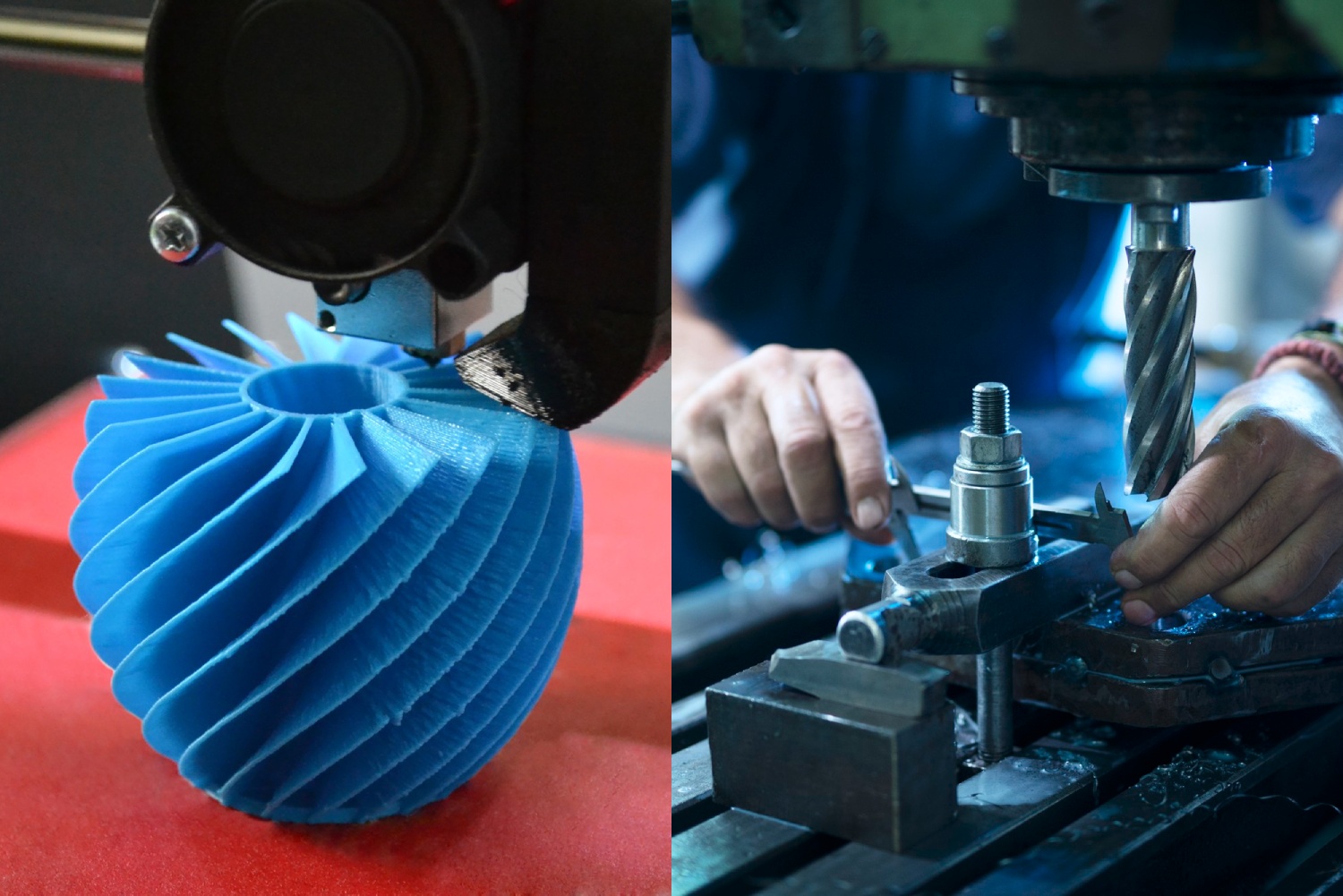
When it comes to modern manufacturing, two technologies stand out, 3D printing and CNC machining. Both play vital roles in product development, yet they differ significantly in process, material compatibility, and outcomes. This blog helps you understand the key differences, benefits, and ideal use cases to choose the best option for your project.
Understanding the Basics
What is 3D Printing?
3D printing, also known as additive manufacturing, builds parts layer by layer from digital models. It’s ideal for rapid prototyping and complex geometries that are hard to achieve using traditional methods. Popular materials include plastics, resins, and metals.
What is CNC Machining?
CNC machining, or Computer Numerical Control machining, is a subtractive manufacturing process. It involves cutting, drilling, or milling material from a solid block (metal or plastic) to create the final part. This process is widely used for precision components and low-volume production.
3D Printing vs CNC Machining: Key Differences
| Factor | 3D Printing | CNC Machining |
|---|---|---|
| Manufacturing Type | Additive | Subtractive |
| Material Waste | Minimal | Moderate to High |
| Complexity | Excellent for complex geometries | Best for simpler designs |
| Accuracy | Good | Higher dimensional accuracy |
| Production Volume | Ideal for prototypes | Suitable for production runs |
| Setup Time | Fast | Requires more setup |
| Material Variety | Expanding, includes plastics & metals | Wide, especially metals |
When to Use 3D Printing
- For Rapid Prototyping:
3D printing shines when you need to bring design ideas to life quickly. It allows for easy design modifications, making it perfect for early-stage product development. - For Complex Designs:
If your part has intricate shapes, internal cavities, or lattice structures, 3D printing is the go-to method. - For Cost Efficiency in Prototyping:
Since it doesn’t require molds or tooling, it’s more affordable for single or limited parts.
Ready to get started on your 3D printed prototype?
Benefits of 3D Printing
- Short lead times
- Minimal material waste
- Excellent design flexibility
- Cost-effective for low-volume runs
When to Use CNC Machining
- For High Precision Components:
CNC machining is known for producing parts with tight tolerances. Industries such as aerospace, medical, and automotive rely heavily on CNC machining services for reliability. - For Functional Prototypes:
When strength, heat resistance, or metal components are required, CNC machining is preferred over additive methods. - For Low-Volume Production:
CNC is ideal for low-volume production runs where consistency and durability matter.
Advantages of CNC Machining
- Superior accuracy and surface finish
- Works with a wide range of materials
- Consistent quality for multiple parts
- Excellent mechanical strength
Additive Manufacturing vs Subtractive Manufacturing
The main distinction between 3D printing and CNC machining lies in their approach.
- Additive manufacturing adds material to create the part, ideal for lightweight structures.
- Subtractive manufacturing removes material to shape the part, preferred for strength and durability.
Choosing between the two depends on your goals, speed and design freedom favor 3D printing, while precision and strength favor CNC machining.
Which One Should You Choose?
If your goal is concept validation, design testing, or early prototypes, 3D printing services are your best choice. If you require high-precision parts, metal components, or production-ready prototypes, CNC machining services are better suited.
In many cases, manufacturers use both processes together, 3D printing for design validation and CNC machining for final part production.
Need a custom solution for your manufacturing needs?
FAQs
Is 3D printing cheaper than CNC machining?
For prototyping and small quantities, yes. 3D printing avoids tooling costs, making it more affordable. However, CNC machining becomes cost-effective for larger production runs.
Can 3D printing replace CNC machining?
Not entirely. While 3D printing is great for design flexibility, CNC machining remains essential for high-strength and precision-critical parts.
Which process is better for metal parts?
CNC machining is typically preferred for metal components, though metal 3D printing is rapidly advancing for specific applications.
What industries use both 3D printing and CNC machining?
Automotive, aerospace, medical devices, and industrial equipment manufacturers often use both to balance speed, accuracy, and cost.