
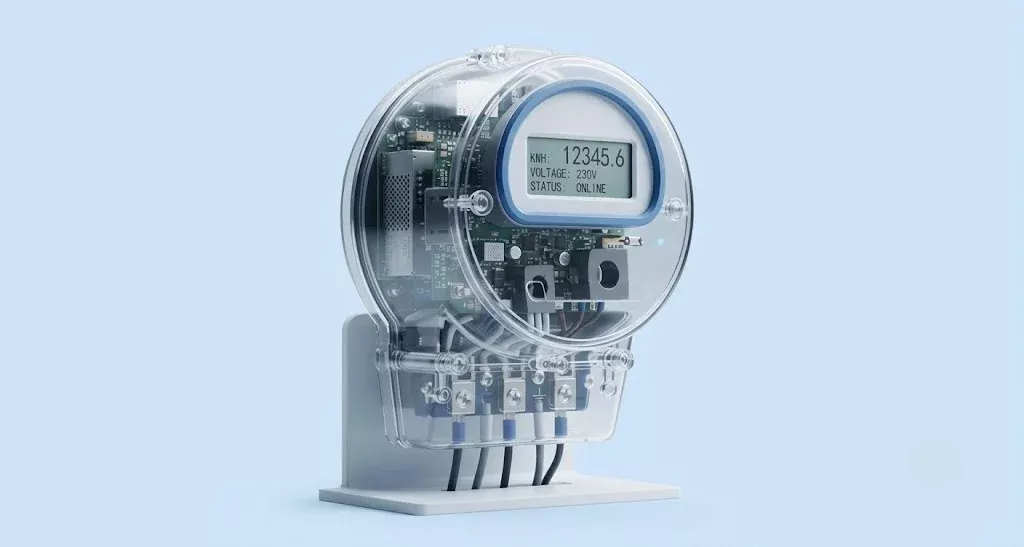
The housing looks like the simplest part of a smart meter. In practice, it is often the part that decides whether a new meter reaches the utility on time.
A smart meter housing has to show the display clearly, protect the electronics, hold the terminals, carry the labels and pass type testing, all while meeting each utility’s own specification. And because manufacturers adapt their meters for different utilities, communication modules, single and three phase configurations and cost targets, the housing usually changes with every new variant.
India’s rollout keeps that pace high. More than 20 crore smart meters have been sanctioned under RDSS, and only about a third had been installed by mid-2026. This guide covers how smart meter housings are prototyped, moulded and finished, from the first clear cover to pre-production supply.
Developing a new smart meter variant?
Parts Of A Smart Meter Housing
A smart meter enclosure is several parts working as one, and each carries a different load.
- The top cover carries a clear window over the display. It must stay clear for the life of the meter, resist scratching and keep the window sealed.
- The base holds the PCB and terminal block, so it carries most of the insulation, heat and mechanical demands.
- The terminal cover protects live connections and is typically sealed against tampering.
All of it is examined at type testing. Smart meters in India are type tested to IS 16444 in independent laboratories, and those tests look closely at the meter case: its construction, its behaviour under heat, and how it survives impact, vibration and climatic conditions.
Prototyping Clear Covers
Transparent parts are where smart meter prototyping is most often underestimated, because clarity, surface finish and stress around the window all change with the process.
| Purpose | Process | What it shows |
| Early fitment | SLA 3D printing in clear resin | Window position, display visibility, fit against the base |
| Functional samples | Vacuum cast clear polyurethane | A small set of clear covers for assembly and handling trials |
| Optical checks | Machined acrylic or PC with vapour polishing | Near-final clarity in a real thermoplastic |
| Testing and approval | Soft-tooled, injection moulded clear PC | The production material, moulded as it will be in production |
Printed and cast clear parts are the most cost-effective way to settle geometry for the first few samples. They are not a substitute for moulded PC when the cover has to pass a test.
Need clear covers for evaluation?
Over-Moulded Top Housings
Many smart meter designs combine an opaque housing and a clear display window in a single top part. Over-moulding opaque PC onto clear PC achieves this in the tool: the clear window is placed in the mould and the opaque housing is moulded onto it, producing one part.
The benefit is one part instead of a window and a frame that must be bonded or gasketed together, with one fewer assembly step and one fewer joint to seal. The process asks more of the tool design. The two materials must bond reliably, the clear area must stay free of flow marks and scratches, and the shut-off around the window must hold its line part after part.
For that reason, an over-moulded top housing is best validated on a soft tool before production tooling is committed. Bonding, flow and appearance issues show up in the first trial parts, when they are still inexpensive to correct.
Inserts, Labels And Finishing
Two more features turn a moulded housing into a meter-ready part. Insert moulding places connector pins in the tool so they are moulded into the part, holding their position without a separate assembly step. UV and pad printing apply labels, logos and information markings directly to the housing, so prototypes and pre-production parts carry the same labels and markings as the final product.
Materials
PC is the common choice for smart meter housings and clear covers. The exact grade depends on the part: flame retardant grades where the specification calls for them, clear and scratch resistant grades for the window, and rubber over-moulded on plastic where a seal is needed.
The grade should be fixed before the tool is designed. Wall thickness, shrinkage and test performance all follow from it, and type test results belong to that grade alone.
From Prototype To Pre-Production Supply
Each process answers a different question, and on a live programme they often overlap. Fitment prints can be checked while the tool is being designed, and a revision found in testing can be confirmed on a printed part while the tool is modified.
| Purpose | Process | Typical lead time |
| Design and fitment | SLA, SLS or MJF 3D printing | 1 to 5 days |
| Functional samples and clear parts | Vacuum casting or CNC machining | Days to two weeks |
| Testing and approvals | Soft tooling and injection moulding in production-intent material | About 4 weeks for a single phase meter tool, 6 weeks for a three phase meter tool |
| Pre-production supply | Low volume moulding from the soft tool | Throughout the tool holding period |
Pre-production supply matters more than it first appears. Programmes often need pilot quantities before full orders, and a soft tool can keep supplying moulded housings while demand is confirmed and production tooling is planned.
How Marcopolo Supports Smart Meter Manufacturers
Marcopolo is a development and manufacturing partner for smart meter manufacturers, supporting each new meter from design to pre-production supply. Product design, DFM and Moldflow analysis lead into prototyping, soft tooling and low volume moulding with flexible MOQs. Concept to production, under one roof.
Capacity is sized for tender timelines: 3D printing capacity of 12,000 cc a day, vacuum casting or RIM capacity of 100 parts a day, and up to 20 tools a month, under an ISO 9001 certified quality system.
Planning inserts or over-moulded windows?
FAQs
What should smart meter housing design cover?
It should address display visibility, PCB and terminal mounting, electrical layout, sealing, tamper-evident features, material selection, assembly, markings, tooling, and the applicable test specification.
Can a clear SLA prototype replace a moulded PC cover?
No. It can support fit and visibility checks, but it does not automatically represent the production grade, moulding behaviour, durability, or test performance.
Why use over-moulding for a smart meter top housing?
Select the exact grade against the component and utility specification. PC is one candidate, but transparency, flame behaviour, UV exposure, impact, and processing must be assessed.
Are printed housings suitable for approval testing?
Only where the agreed test programme accepts them. Tests dependent on production material or moulding require representative samples specified with the laboratory.
Which material should be used for smart meter housings?
Select the exact grade against the component and utility specification. PC is one candidate, but transparency, flame behaviour, UV exposure, impact, and processing must be assessed.
When should production tooling replace soft tooling?
When design stability, approved material, forecast demand, tool-life requirements, and process qualification justify the investment. Review part equivalence during the transition.