
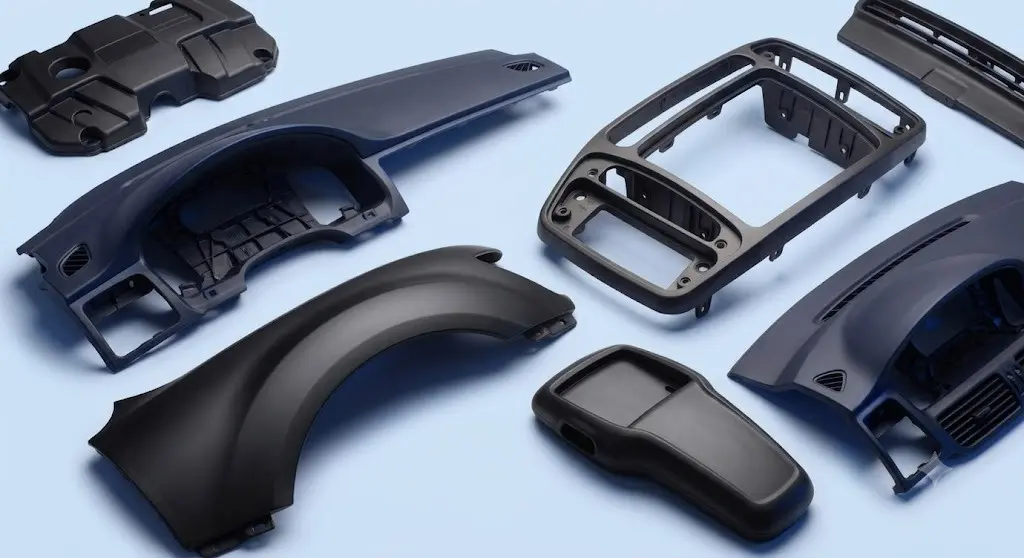
Large plastic parts can be difficult to manufacture economically at low or medium volumes. Conventional injection moulding may require expensive tooling, high clamping force, and a larger commitment before the design or demand is proven.
Reaction injection moulding, or RIM, provides another option. It uses liquid reactive components that are mixed and injected into a mould, where they react and cure into rigid or flexible polyurethane parts. The low-pressure process can suit large, lightweight, complex components, functional prototypes, pilot builds, and selected low-volume production.
For product teams looking for flexible large-part manufacturing, RIM moulding India is gaining relevance because it can connect DFM, tooling, material selection, production, painting, assembly, and inspection through one workflow.
Need a large functional part?
What is reaction injection moulding?
Reaction injection moulding is a moulding process that typically uses two liquid components, often polyol and isocyanate. They are metered, mixed, injected into a closed mould, and chemically react to form a polyurethane part.
Unlike thermoplastic injection moulding, which injects melted plastic pellets, RIM forms the part through a chemical reaction inside the mould. This can allow lower-pressure filling and tooling options that suit certain large or low-to-medium-volume components.
| Process feature | Reaction injection moulding |
| Feedstock | Liquid reactive components |
| Common material family | Polyurethane systems |
| Pressure | Lower than conventional injection moulding |
| Tooling direction | Lower cost tooling depending on application |
| Typical use | Large parts, prototypes, pilot builds, low-to-medium volumes |
| Output | Rigid, flexible, structural, or appearance-focused polyurethane parts |
How the RIM process works
- Design and DFM: CAD, wall thickness, draft, parting lines, gates, vents, inserts, undercuts, and finish are reviewed.
- Material preparation: Components are conditioned and controlled according to the selected formulation.
- Metering and mixing: Liquid components are mixed at the required ratio through a specialised mixing head.
- Low-pressure injection: The mixed material fills the closed mould.
- Reaction and curing: The chemical reaction creates the polyurethane part inside the mould.
- Demoulding and finishing: Parts may be trimmed, drilled, painted, coated, assembled, and inspected.
Marcopolo lists controlled casting, painting, assembly, insert integration, and stage-wise inspection as part of its RIM and vacuum-casting capabilities.
Why RIM moulding India is gaining ground
RIM moulding India is useful when companies need large, complex polyurethane parts without immediate investment in hardened mass-production tooling. It can support regional development, pilot production, industrial equipment, automotive programmes, and controlled low-volume manufacturing.
Marcopolo’s dedicated RIM facility is designed for large parts up to 2 meters in a single piece, engineered polyurethane materials, DFM review, painting, assembly, and production of selected low-volume parts.
The value is not only lower tooling cost. A capable RIM partner can reduce handoffs by managing design review, mould development, material selection, finishing, and inspection together.
Considering RIM moulding India?
When should you use RIM?
Reaction injection moulding should be evaluated when a part is large, lightweight, complex, or required in smaller production quantities. It can also suit parts that need functional validation or realistic appearance before high-volume tooling is justified.
| Requirement | Why RIM may fit |
| Large part footprint | Low-viscosity reactive materials can fill large cavities |
| Low or medium volume | Tooling route can be more flexible than hardened high-volume tooling |
| Complex exterior form | Supports detailed surfaces and styling |
| Functional prototype | Provides production-like polyurethane parts |
| Pilot or launch build | Helps validate product and process before scale-up |
| Large enclosure or cover | Can reduce assembly by producing a larger single part |
Material selection for RIM
Polyurethane is the main material family used for RIM. The right formulation depends on hardness, density, stiffness, impact performance, temperature, chemical exposure, colour, surface finish, flame requirements, and end use.
Marcopolo offers polyurethane grades that mimic selected ABS, PP, PC, PA, POM, and HDPE characteristics, along with elastomeric and flame-retardant PU options for appropriate applications.
A material that mimics a thermoplastic may reproduce selected appearance or functional characteristics, but it is not automatically chemically or mechanically identical to that thermoplastic. Confirm the required grade and validation plan before approval.
RIM design and DFM considerations
RIM success depends on early design review. Check wall-thickness transitions, draft, demoulding, parting lines, gate and vent locations, inserts, surface finish, trimming, painting, and sealing.
Large parts need particular attention because filling, cure, flash, surface quality, and distortion can be affected by geometry and mould design. A DFM review should be completed before mould development.
Our process experts review designs to optimise geometry, reduce defects, and improve mould performance.
Have a complex CAD model?
RIM versus conventional injection moulding
RIM is not a replacement for conventional injection moulding in every project. Conventional injection moulding can be the better choice for higher-volume thermoplastic parts requiring fast cycles, established resin choices, and high repeatability.
RIM may be a stronger option for larger polyurethane parts, low-to-medium volumes, flexible tooling needs, and early production stages. The process should be selected based on total cost, material performance, part geometry, tolerance, finish, quantity, and scale-up plan.
Choosing a RIM supplier in India
Do not assess a RIM moulding India supplier only by machine availability. Review DFM capability, material selection, tooling experience, large-part capacity, finishing, quality inspection, low-volume support, and engineering communication.
Marcopolo supports RIM, vacuum casting, tooling, injection moulding, machining, assembly, and contract manufacturing. This allows teams to compare routes and choose the process that fits the part, volume, and performance requirement.
Conclusion
Reaction injection moulding is a practical option for large, complex, lightweight, and low-to-medium-volume polyurethane parts. Its lower-pressure process and flexible tooling approach can bridge the gap between prototypes and conventional production.
For businesses evaluating RIM moulding India, the key is to choose a partner that connects DFM, material selection, mould development, finishing, quality checks, and delivery—not just the RIM process itself.
Ready to evaluate RIM?
FAQs
What is reaction injection moulding?
It is a low-pressure process in which liquid reactive components are mixed and cure inside a mould to create a polyurethane part.
What is RIM moulding India?
It refers to reaction injection moulding services in India for prototypes, large plastic parts, pilot batches, and low-to-medium-volume production.
What materials are used in RIM?
Polyurethane systems are most common. They can be rigid, flexible, elastomeric, flame-retardant, reinforced, or formulated for selected performance requirements.
Is RIM suitable for large parts?
Yes. RIM is often considered for large and complex components. Marcopolo states that it can produce RIM parts up to 2 metres in a single piece.
Is RIM cheaper than conventional injection moulding?
It can reduce upfront tooling cost for suitable low-to-medium-volume parts, but total cost depends on material, tooling, part size, finish, quantity, inspection, and cycle time.
Can RIM parts be painted or assembled?
Yes. RIM parts can be trimmed, painted, coated, assembled, and inspected when these requirements are planned into the process.
What quantities are suitable for RIM?
RIM is commonly evaluated for prototypes, pilot builds, low-volume production, and selected medium-volume programmes. The right quantity is project-specific.
Can RIM include inserts?
Insert integration may be possible, but insert material, geometry, adhesion, thermal behaviour, and load path must be reviewed during DFM.