
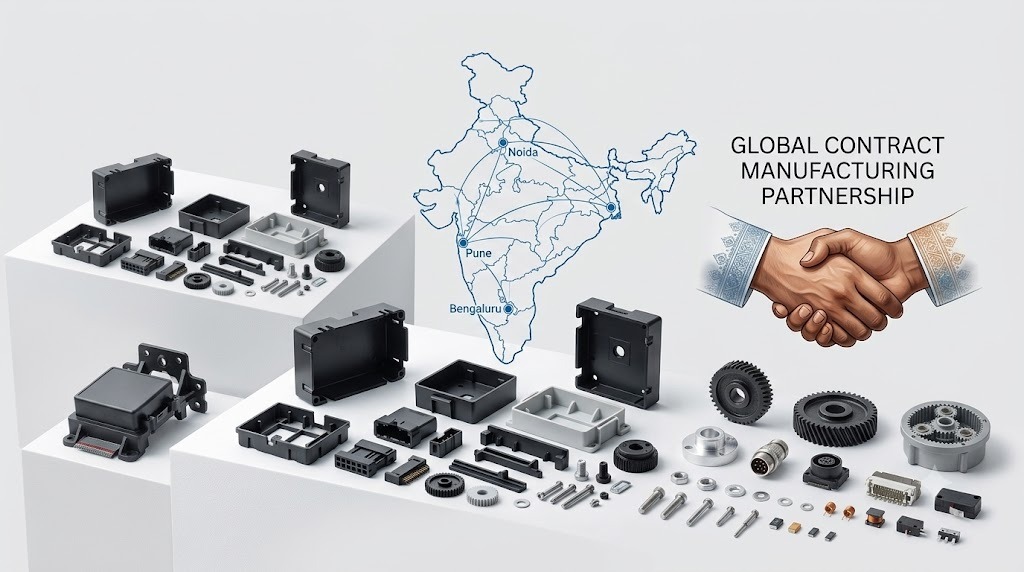
India’s EMS sector is growing above 20 percent annually. Global OEMs are actively diversifying supply chains away from China, and Indian EMS companies are winning large scale contracts as a result. The government’s Electronics Components Manufacturing Scheme, approved with an approximately USD 2.75 billion outlay, is creating direct incentives for Indian EMS companies to build stronger domestic component ecosystems.
That makes an EMS company plastic components partner strategically important. Electronic enclosures, housings, bezels, buttons, connectors, sensor covers, brackets, and internal plastic parts need dedicated material, tooling, moulding, quality, and assembly expertise.
Effective plastic component sourcing for electronics manufacturing requires more than a competitive part quote. The supplier must understand electrical safety, flame performance, thermal exposure, fitment, surface finish, assembly, tolerance, volume, and delivery needs.
Marcopolo partners with electronics companies as a contract manufacturer for plastic parts, supporting DFM, prototyping, soft tooling, injection moulding, assembly, printing, and scalable production.
Need reliable electronics plastic parts?
Why electronic plastic parts are not a commodity
A plastic housing does more than cover electronics. It may protect components, support heat management, maintain creepage and clearance, enable assembly, carry branding, resist impact, and help a product meet its intended safety requirements.
| Electronics requirement | Plastic-part consideration |
| Electrical insulation | Grade-specific dielectric performance and geometry |
| Flame requirement | Correct FR material, thickness, and test requirement |
| Heat exposure | Continuous-use and heat-deflection performance |
| Mechanical protection | Impact strength, ribs, bosses, and wall thickness |
| Appearance | Texture, gloss, colour, weld lines, and finish |
| Assembly | Screws, clips, inserts, ultrasonic welding, and access |
| Environment | UV, humidity, chemicals, dust, and ingress needs |
A plastic part that is poorly designed or wrongly specified can create assembly delays, cosmetic defects, thermal issues, or expensive tooling modifications.
What EMS companies need from a plastic partner
A reliable partner should support the full development path:
- DFM and mouldflow review before tooling.
- 3D printing and functional prototypes.
- Vacuum casting or RIM for selected early and low-volume parts.
- Soft tooling for pilot or pre-production builds.
- Injection moulding for repeatable production.
- Machining for precision or validation components.
- Insert moulding, printing, welding, finishing, and assembly.
- Dimensional inspection, material documentation, and batch records.
Marcopolo’s electronics capability includes DFM, mouldflow, prototyping, soft tooling, injection moulding, FR and ESD-safe material options, printing, assembly, and ultrasonic welding.
Start with DFM before tooling
DFM is one of the most valuable steps in plastic component sourcing for electronics manufacturing. It identifies issues before tooling, when design changes are less costly.
For electronic housings and components, review wall thickness, draft, ribs, screw towers, clips, snap fits, PCB mounting points, connector interfaces, parting lines, gates, ejection, weld lines, warpage, finish, and assembly sequence.
A DFM review is most effective when the supplier receives the 3D CAD, 2D drawing, material callout, critical dimensions, expected volumes, finish requirements, and relevant test conditions.
Planning a pilot build?
Material selection for electronics parts
Material should be chosen for the actual product requirement. ABS, PC, PC-ABS, PA, POM, PP, PMMA, and other engineering plastics can suit different housings, covers, brackets, clips, and functional components.
Flame-retardant materials may be required for power modules, PCB enclosures, chargers, or control systems. The relevant rating must be verified for the exact material grade, colour, thickness, and test condition. A UL 94 material rating does not by itself certify the finished electronic product.
For demanding applications, PEEK, PPS, ULTEM™ (PEI), or other high-performance materials may be considered for thermal, electrical, chemical, or dimensional requirements. Material choice must be confirmed against the specific grade and process.
Low-volume production and flexible tooling
EMS programmes often need components before the final market volume is known. A project may require a few prototypes, customer samples, a pilot batch, or a limited launch before hard tooling makes commercial sense.
| Programme stage | Typical need | Suitable route |
| Engineering validation | Fit, assembly, and thermal checks | 3D printing, machining, vacuum casting |
| Customer pilot | Production-like parts | Soft tooling, RIM, injection moulding |
| Limited launch | Repeatable smaller batches | Injection moulding and assembly |
| Scale-up | Stable high-volume output | Production tooling and repeat runs |
Soft tooling delivers production-intent parts in exact engineering plastic, making it a practical route for pilot builds and pre-series production before full production tooling is justified. Lead times run 2 to 6 weeks with MOQ as low as 20 units.
Large enclosures and RIM
Large electronic enclosures may not always suit conventional injection moulding, especially during early or medium-volume production. Reaction injection moulding can be evaluated for selected large, lightweight polyurethane housings and covers.
Marcopolo’s RIM facility supports large parts up to 2 metres, polyurethane grades that mimic selected engineering plastics, painting, assembly, and stage-wise quality checks. The right process still depends on size, geometry, material, cosmetic requirements, quantity, and performance expectations.
Why integration matters for EMS programmes
A partner that only moulds a part can create handoffs between design, tooling, printing, assembly, inspection, and delivery. Each handoff can add communication gaps, duplicate checks, and slow engineering changes.
Marcopolo’s electronics and broader manufacturing capabilities connect design support, rapid prototyping, tooling, injection moulding, RIM, vacuum casting, printing, assembly, and quality checks.
For EMS companies, this can simplify supplier coordination and support a faster transition from prototype to pilot and production.
Need support from enclosure design to assembly?
Supplier evaluation checklist
Before choosing an EMS company plastic components partner, ask:
- Can the team provide DFM and mouldflow support?
- Can it process the specified engineering, FR, or ESD-safe material?
- Can it provide prototypes, pilot builds, and repeat production?
- Can it build, modify, and maintain the required tool?
- Are CMM/VMM, first-article, and dimensional reports available?
- Can it provide printing, inserts, welding, and assembly?
- Are material and batch records maintained?
- Can it support future volume growth and engineering changes?
Conclusion
Electronic plastic components affect product safety, reliability, appearance, assembly, and manufacturing efficiency. EMS companies need more than a basic moulding supplier; they need an engineering-led plastic partner that can support material selection, DFM, tooling, pilot quantities, production, inspection, and assembly.
Marcopolo supports electronics companies with prototype-to-production services for enclosures, connectors, bezels, buttons, sensor housings, and related plastic components.
Ready to source electronics plastic parts?
FAQs
What plastic components do EMS companies source?
Common examples include enclosures, housings, bezels, buttons, sensor covers, brackets, connector bodies, battery covers, fan ducts, and insulation parts.
Why do EMS companies need a specialised plastic partner?
Plastic parts require engineering in material selection, DFM, tooling, moulding, inspection, and assembly that may sit outside standard PCB assembly capability.
What is plastic component sourcing for electronics manufacturing?
It is the process of designing, validating, tooling, manufacturing, inspecting, and delivering plastic components for electronic products.
Which plastics are used for electronics enclosures?
ABS, PC, PC-ABS, PA, PP, POM, FR grades, ESD-safe grades, and high-performance plastics may be selected based on application requirements.
Does UL 94 V-0 mean?
It is a material flammability classification based on controlled vertical testing. The rating must be confirmed for the exact grade, colour, thickness, and test conditions.
Does UL 94 V-0 certify the full product?
No. It relates to tested plastic material behaviour and does not automatically certify the whole electronic product or enclosure system.
Can EMS companies order low-volume plastic components?
Yes. Prototype, pilot, and limited-launch quantities can use 3D printing, machining, vacuum casting, RIM, soft tooling, or injection moulding depending on the requirement.
When should DFM be performed for an enclosure?
Before tooling begins, while wall thickness, bosses, clips, draft, gates, ejection, and assembly details can still be changed.