
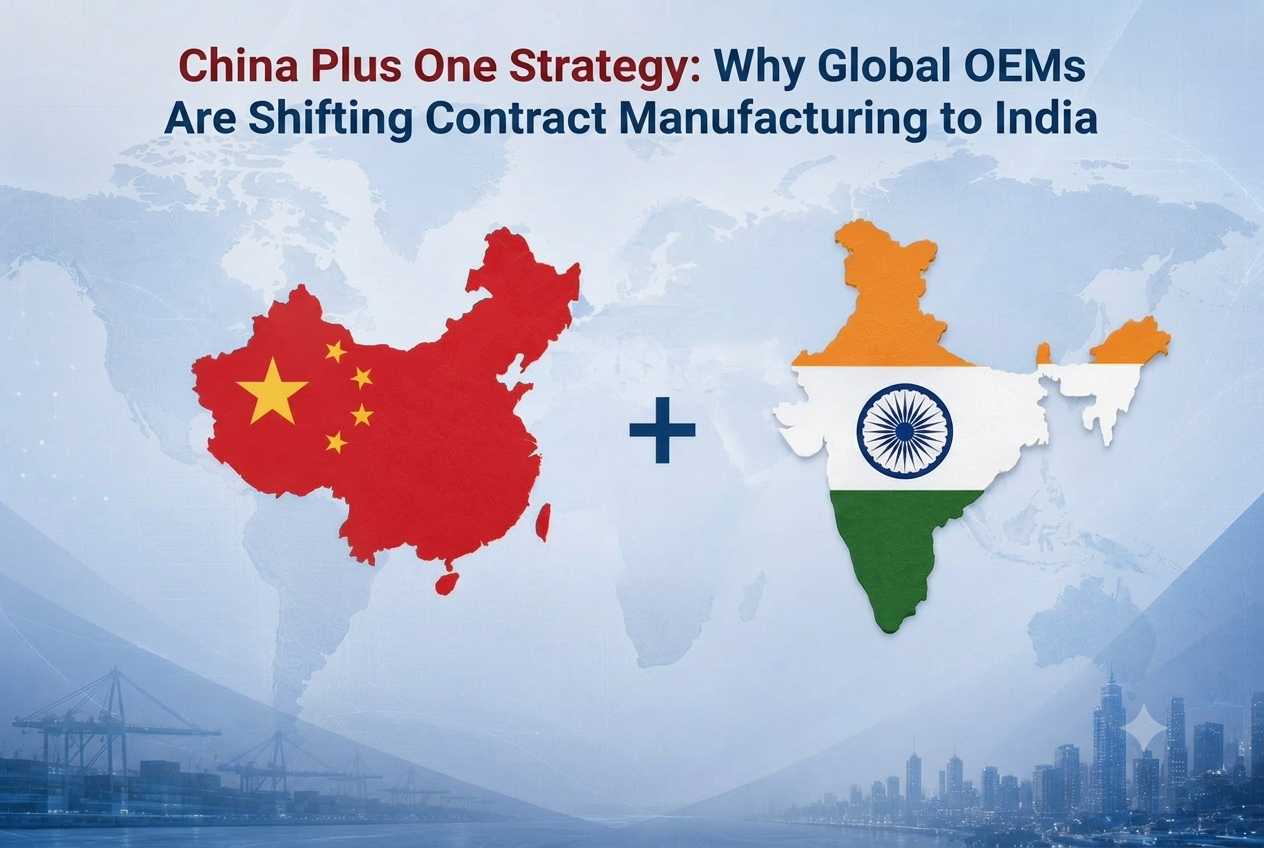
For many years, China was the default location for global manufacturing. Its supplier base, scale, infrastructure, and established production networks were hard to match. Today, many companies are building more resilient supply chains through the China Plus One strategy.
China Plus One does not necessarily mean leaving China. It means keeping China in the supply chain while qualifying manufacturing or sourcing capacity in at least one additional country. The goal is to reduce single-country dependency, improve continuity, and create more flexibility for future production.
India is increasingly part of that discussion because it combines engineering talent, a broad industrial base, a growing supplier ecosystem, and expanding strategic manufacturing support. Marcopolo supports this transition with design support, prototyping, tooling, injection moulding, assembly, and low-volume contract manufacturing.
What is the China Plus One strategy?
The China Plus One strategy is a supply-chain diversification approach. A company retains its existing China operations but develops a second qualified source or production location in another country.
This can involve selected components, pilot production, regional assembly, new product launches, or controlled production allocation. It is not an automatic one-for-one replacement of China.
| China-only approach | China Plus One approach |
| Heavy dependence on one geography | Multiple qualified manufacturing locations |
| One disruption can affect the full programme. | More options for capacity and sourcing |
| Single-country supplier concentration | Improved supply-chain resilience |
| Limited regional flexibility | Better ability to serve diverse markets |
Why global OEMs are diversifying
The shift is driven by more than labour cost. Global OEMs are responding to supply-chain disruption, logistics uncertainty, trade-policy changes, customer expectations for regional supply, and the need for more flexible capacity during product launches.
A China Plus One strategy is therefore a risk-management and growth-planning decision. It helps companies reduce concentration risk while retaining the benefits of existing suppliers and processes.
Why India is attracting attention
India is not the only China Plus One option, but it offers a unique combination of engineering depth, industrial diversity, a large domestic market, and government support for strategic manufacturing sectors. The strength of India’s engineering ecosystem is evident in companies like Siemens, which has over 10,000 engineers based in India working across automotive, industrial, semiconductor, and medical device programs. India is not just a manufacturing destination; it is emerging as a strategic engineering hub for global companies.
Invest India reports that total FDI inflows reached US$94.53 billion in FY 2025–26, with manufacturing among the fastest-growing areas. The Government of India’s PLI schemes cover 14 strategic sectors, including electronics, pharmaceuticals, medical devices, automobiles and auto components, ACC batteries, telecom, solar PV, white goods, and drones.
| India’s advantage | Relevance to OEMs |
| Engineering talent | Supports DFM, validation, drawing updates, and process development |
| Industrial diversity | Supports automotive, electronics, medical, and industrial programmes |
| Supplier ecosystem | Creates options for tooling, moulding, assembly, and finishing |
| Domestic market | Adds a potential market alongside export opportunity |
| English-language communication | Simplifies technical documentation and engineering coordination |
Considering India for production?
Cost: look beyond unit price
A China Plus One strategy should be assessed using total program cost, not part price alone. Compare tooling, engineering, inspection, freight, customs, inventory, qualification, rework, and disruption risk.
A supplier with a slightly higher unit price may still provide better total value if it reduces handoffs, improves DFM, supports pilot production, and lowers supply-chain risk.
Like other engineering materials, ULTEM needs appropriate drying, moulding conditions, draft, wall thickness, and surface-finish planning. Confirm chemical compatibility and grade-specific documentation for demanding industrial use.
Why contract manufacturing in India fits
Contract manufacturing in India lets OEMs build a second source without investing immediately in a complete local facility. The right partner can support CAD review, prototype development, tooling, production, assembly, inspection, and delivery.
Marcopolo’s contract manufacturing service includes DFM, fitment prototypes, functional prototypes, soft and production tooling, injection moulding, RIM, machining, post-moulding operations, and sub-assembly support.
This is useful when teams need to qualify a component gradually rather than transfer an entire programme at once.
A practical implementation approach
- Choose the right component. Start with a part that has clear specifications, manageable qualification needs, and a practical reason for regional production.
- Map the existing process. Document material, tool ownership, process parameters, inspection plan, volume, and delivery requirements.
- Evaluate suppliers. Review engineering capability, quality systems, tooling, capacity, export readiness, and communication.
- Begin with DFM and prototypes. Validate geometry, material, tolerance, and manufacturing route before production tooling.
- Run a pilot batch. Check dimensions, assembly, material documents, packaging, quality records, and delivery performance.
- Qualify and scale. Complete required approvals, then allocate volume in a controlled way.
This phased approach creates evidence before major investment and reduces the risk of an unplanned transfer.
What global OEMs should expect
A China Plus One manufacturing partner needs more than machine capacity. It should support engineering engagement before tooling, end-to-end process capability, low-volume pilot production, controlled documentation, and clear communication across locations. The ability to produce a part cheaply is not the same as the ability to qualify a part for an OEM program.
Marcopolo offers design support, 3D printing, vacuum casting, RIM, machining, tooling, injection moulding, assembly, and low-volume production through one integrated manufacturing workflow.
For automotive programmes, Marcopolo supports low-volume runs using silicone moulding or soft tooling for early development and pilot builds.
Need to qualify an Indian supplier?
Supplier evaluation checklist
Before appointing a manufacturing partner in India, check:
- Engineering capability and DFM support.
- Ability to process the specified material and tolerance.
- Tool ownership, maintenance, and modification terms.
- Current quality certifications and inspection systems.
- Prototype, pilot, and production capacity.
- Material, process, and batch traceability.
- Export documentation and logistics planning.
- Response time for engineering changes.
- Business continuity and backup plans.
Always verify current certificates, capacity, and project-specific claims directly during supplier qualification.
Conclusion
The China Plus One strategy is not about abandoning China overnight. It is about building a more resilient supply chain by adding qualified manufacturing capacity elsewhere.
India is a strong option for global OEMs that need engineering support, tooling, pilot builds, low-volume production, and scalable contract manufacturing. The best starting point is a defined component, DFM review, prototype, pilot batch, and documented qualification plan.
Ready to evaluate India?
FAQs
What is the China Plus One strategy?
It is a diversification model in which companies retain China in their supply chain while adding production or sourcing capacity in another country.
Does China Plus One mean leaving China?
No. It generally means reducing overdependence on one country rather than replacing China completely.
Why is India considered for China Plus One manufacturing?
India offers engineering talent, industrial breadth, supplier development, a large market, and support for strategic manufacturing sectors.
Can OEMs use contract manufacturing in India?
Yes. A capable partner can support DFM, prototyping, tooling, manufacturing, assembly, inspection, and delivery.
What should an OEM compare before selecting India?
Compare total landed cost, tooling, quality, lead time, logistics, inventory, qualification, capacity, and supply-chain risk.
How should an OEM start a China Plus One programme?
Start with a defined part, supplier evaluation, DFM, prototypes, a pilot batch, quality approval, and controlled scale-up.
Which industries can benefit?
Automotive, EV, electronics, medical devices, industrial equipment, appliances, and other engineered-product programs can benefit when the supplier fit is right.