
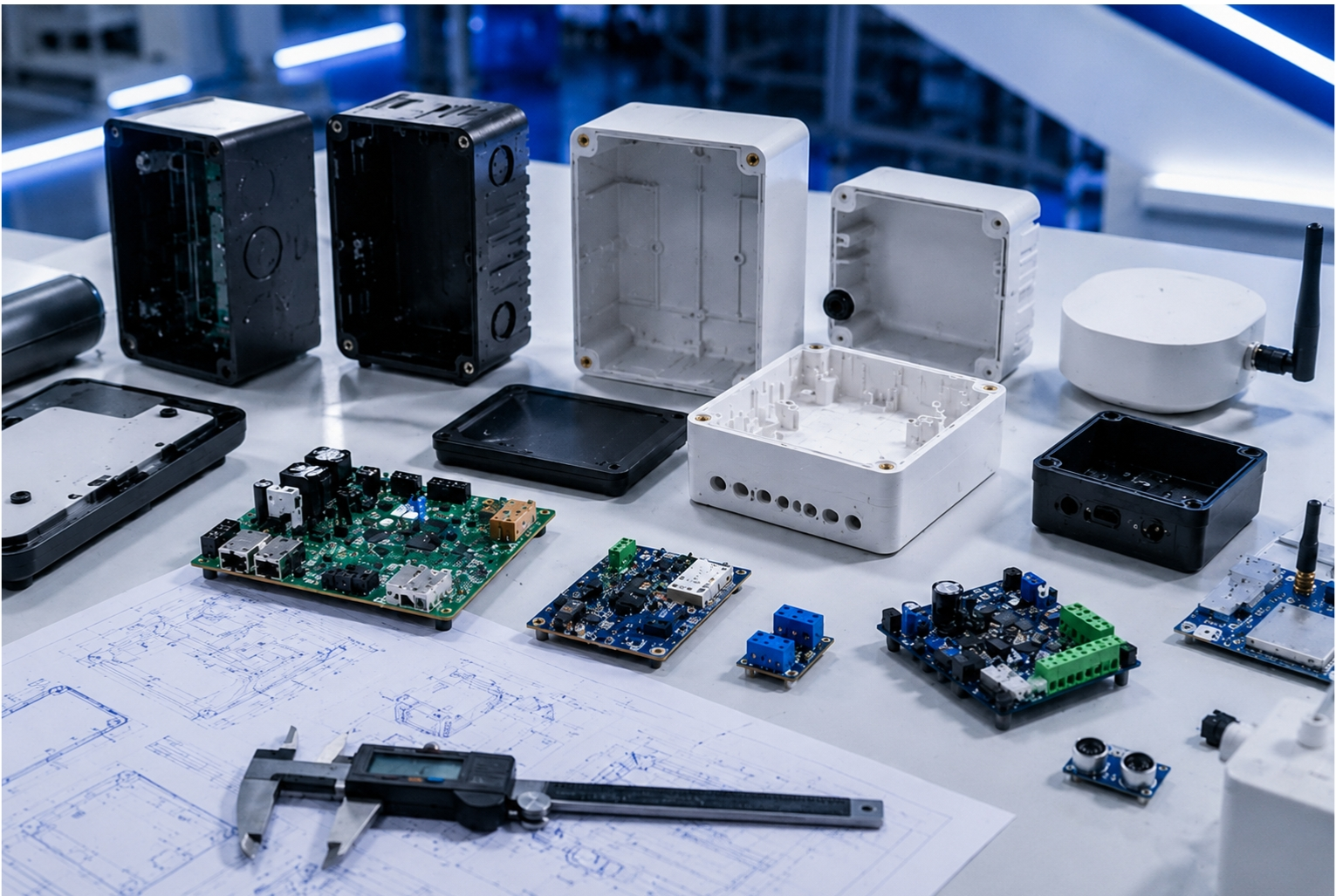
An electronics enclosure looks like a simple design problem — a box that holds a PCB and keeps the environment out. The decisions that actually determine whether it works are the material grade and the tolerance, and both get specified wrong more often than the geometry does.
This breaks down how to match material grade and tolerance to the actual failure mode and function in plastic enclosures for electronics and IoT devices — not the catalogue default, and not the tightest spec on the page.
Need help specifying your enclosure correctly?
Material Grade: Matched to the Failure Mode, Not the Catalogue Default
Each material grade in an electronics enclosure exists to prevent a specific failure, not as a generic upgrade.
| Material Grade | Use Case | Risk It Prevents |
|---|---|---|
| FR-Grade Plastics | Housings, covers, and enclosures near power supplies or switching components | Failing UL94 fire-safety requirements |
| ESD-Safe Grades | Assemblies housing sensitive ICs or static-vulnerable components | Component damage during handling, assembly, or field service |
| Diffusivity-Grade Polymers | LED light guides and indicator panels | Inconsistent optical transmission across an indicator array |
| Scratch-Resistant Transparent Grades | Display covers and optical windows | Clouding or scratching after years of handling |
| Standard Engineering Plastics (ABS, PC, PC-ABS, Nylon, POM) | General-purpose housings, structural shells, and covers | None of the above apply—no premium material needed |
| High-Performance Plastics (PEEK, ULTEM) | Enclosures near motors, drives, or heat-generating assemblies | Standard engineering plastics not being rated for the operating temperature |
FR–Grade Plastics are required wherever the enclosure sits near a power supply, switching component, or anything that can generate heat or arc under fault conditions. This isn‘t a default specification — it’s required when the application calls for it, and skipping it where it’s required is a certification failure, not a cost saving.
ESD–Safe Grades are necessary for any assembly housing sensitive ICs or components vulnerable to electrostatic discharge. The risk here isn‘t enclosure failure — it’s the enclosure failing to protect what’s inside it.
Diffusivity-Grade Polymers are used specifically for LED light guides and indicator panels, where the material‘s optical transmission properties matter as much as its mechanical ones. A standard transparent grade will pass a visual check and then perform inconsistently once it’s actually diffusing light across an indicator array.
Scratch–Resistant Transparent Grades suit display covers and optical windows that need to stay clear after years of handling, not just at the point of assembly.
Standard Engineering Plastics — ABS, PC, PC–ABS, Nylon, and POM — cover the majority of general-purpose housings, structural shells, and covers where none of the above failure modes apply.
High–Performance Plastics — PEEK and ULTEM — come into play for enclosures mounted near motors, drives, or other heat-generating assemblies, where standard engineering plastics aren‘t rated for the operating temperature.
The right grade is the one matched to the actual risk in the application — not the highest-spec material on the list, and not the cheapest one that happens to look the same on a sample part.
Not sure which grade your design actually needs?
Tolerance: Matched to the Function, Not Maximised by Default
Tolerance decisions follow the same logic. Tighter isn‘t automatically better — it’s more expensive, and unnecessary precision on a feature that doesn‘t need it adds cost without adding reliability.
| Feature Type | Process | Tolerance |
|---|---|---|
| General enclosure fit and snap features | Soft tooling / production tooling | ±0.02–0.05 mm |
| PCB fitment and connector alignment | CNC machining | ±0.02 mm |
| Small-form-factor IoT components with tight spacing | CNC machining | Down to 10 microns, where genuinely required |
Where a feature has to align precisely with a board edge, connector, or mounting point, CNC machining is usually the right call rather than relying on moulding tolerance alone. For the tightest precision applications — small–form–factor IoT devices where component spacing leaves very little margin — tolerances down to 10 microns are achievable on the components that genuinely require it.
A tolerance call that’s tighter than the function requires doesn‘t just cost more in tooling and inspection — it can also extend lead time without improving the part. The right approach is to specify tight tolerance only on the features where misalignment actually causes a functional problem, and let the rest of the part run at standard moulding tolerance.
Matching Process to the Decision You've Made
| Process | Role | Materials |
|---|---|---|
| 3D Printing | Early fitment check — confirm PCB fit and connector cutout alignment before any grade or tolerance decision is locked in | SLA, SLS material equivalents |
| Vacuum Casting & RIM | Functional validation of a larger enclosure or housing geometry before tooling | Production-equivalent polyurethane |
| Soft Tooling | Production-intent material validation — the actual specified grade tested for real | FR-rated, ESD-safe, diffusivity, or standard engineering plastic; 100–5,000 parts, 2–6 weeks |
| Machining | Tight-tolerance features — connector cutouts, board mounts, alignment points | Production material at ±0.02 mm or tighter |
| Production Tooling | Scaling past validation once material and tolerance are confirmed | Same specification carried forward, no re-qualification |
What This Looks Like in Practice
- A smart meter enclosure prototyped and functionally validated in short lead times before committing to tooling.
- Switchgear components 3D printed with enough accuracy to confirm fitment against an existing electronic assembly before any material grade decision was finalised.
- IoT device parts machined to ten–micron tolerance where component spacing left no margin for a looser spec.
None of these started with the tightest tolerance or the highest-spec material available — they started with the actual functional requirement, and the material and tolerance followed from that.
Why Manufacturers Choose Marcopolo for Electronics Enclosures
- 25+ years of experience.
- 1,400+ tools delivered.
- FR-rated, ESD-safe and diffusivity grades in-house.
- Prototype to production under one roof.
Our Capabilities for Electronics and IoT Enclosures
| Stage | Service |
|---|---|
| Early fitment check | 3D Printing |
| Functional validation | Vacuum Casting & RIM |
| Tight-tolerance features | Machining |
| Material grade validation & low-volume production | Soft & Production Tooling |
| Scaling | Injection Moulding |
| Industry focus | Industrial Electronics |
Share your enclosure design, the components it needs to protect. Our engineering team will recommend the material grade and tolerance that match the actual application — not the most conservative spec on the page — and the right process to validate it before tooling.
Specify the Right Grade and Tolerance From the Start
FAQs
When is FR-grade plastic required for an electronics enclosure?
Whenever the enclosure sits near a power supply, switching component, or anything that can generate heat or arc under fault conditions — typically to meet UL94 fire safety classifications.
What's the difference between ESD-safe and standard plastic for electronics housings?
ESD-safe grades dissipate static charge to protect sensitive ICs and components during handling, assembly, and field service. Standard ABS or PC offers no such protection and can allow static discharge to damage the components inside.
What tolerance can a plastic IoT enclosure hold?
Standard soft-tooled or production-tooled features hold ±0.02 to 0.05mm. Features that must align precisely with a PCB or connector are usually machined at ±0.02mm, and the tightest small–form–factor designs can achieve tolerances down to 10 microns where genuinely required.
Can one enclosure use more than one material grade?
Yes. It’s common for a housing to use a standard engineering plastic for the main shell while a diffusivity-grade or scratch-resistant grade is used only for the indicator panel or display window — matching each material to the specific function it serves.
How do I validate material grade and tolerance before committing to tooling?
3D printing or vacuum casting confirms fitment early, soft tooling validates the actual specified material grade in production–intent form at 100–5,000 parts, and machining handles any feature that needs tighter tolerance than moulding alone delivers.
Does a tighter tolerance always mean a better enclosure?
No. Tolerance tighter than the function requires adds cost and can extend lead time without improving reliability. The right approach specifies tight tolerance only where misalignment would cause an actual functional problem.