
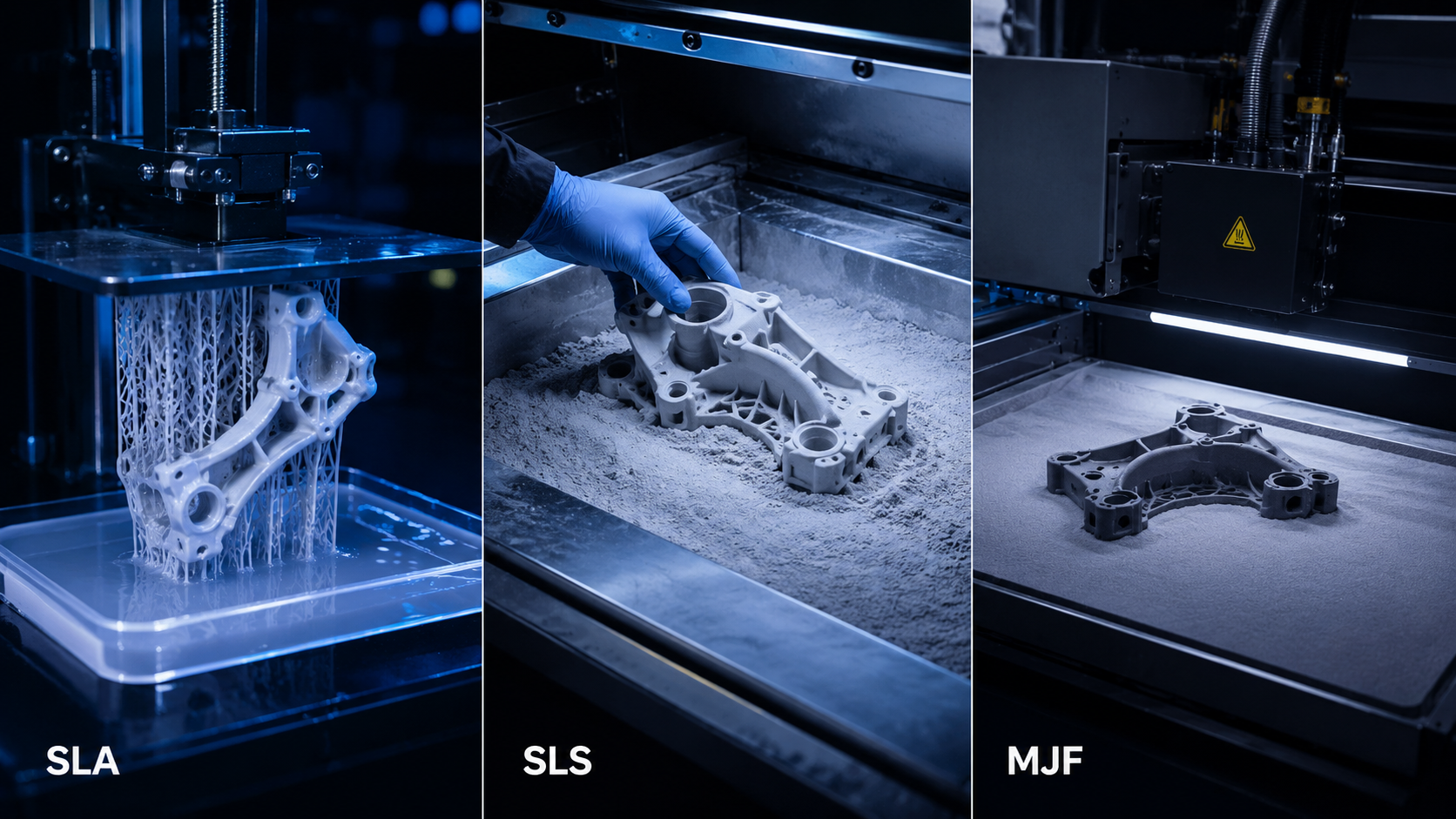
SLA vs SLS 3D Printing: Which Technology Delivers Better Results?
Choosing the right 3D printing process depends entirely on what you need the part to do. Are you validating a design for a board review? Testing a functional assembly under load? Producing a pilot batch before committing to tooling? Each of these scenarios points to a different process, and selecting the wrong one can add unnecessary time and iteration cycles.
At Marcopolo, we operate industrial-grade SLA, SLS, and MJF machines in-house. Every week, our engineers help product development teams across automotive, medical devices, industrial electronics, and robotics make this decision. This practical guide compares key technologies and helps you identify the right fit for your specific application.
Why Compare MJF vs SLA vs SLS 3d printing?
Before diving into the SLA vs SLS 3D printing debate, it helps to understand why 3D printing earns its place in product development:
- Short lead times: Prototypes in as little as 1-3 days, versus weeks for tooled parts
- Minimal material waste: Additive manufacturing builds only what is needed
- Excellent design flexibility: Complex geometries, internal channels, and undercuts that traditional manufacturing cannot produce cost-effectively
- Cost-effective for low-volume runs: No tooling investment required for small quantities
Understanding these benefits sets the foundation for evaluating which best 3D printing technology fits your needs.
How Each 3D Printing Technology Works
SLA – Stereolithography (For Visual Precision)
A UV laser cures liquid photopolymer resin layer by layer, building up a dimensionally precise part with a smooth, high-quality surface finish. Support structures are added during the build and removed manually after printing.
Marcopolo’s large-format SLA machines support build volumes up to 800 x 800 x 500 mm, making full-size single-piece fitment models and transparent components possible.
| Specification | Detail |
|---|---|
| Best for | Visual prototypes, fitment validation, display models, CMF checks, transparent components |
| Materials | ABS-like, PC-like (clear), rigid and flexible resin variants |
| Accuracy | ±0.1 mm per 100 mm (tightest of the three) |
| Lead time | 1-3 working days; up to 5 days for large or complex builds |
SLS – Selective Laser Sintering (For Functional Nylon)
A high-power laser sinters nylon powder layer by layer inside a heated chamber. No support structures are needed as the surrounding powder supports the part naturally, which makes SLS ideal for complex geometries without design compromise.
For mechanical performance, SLS parts are genuine nylon thermoplastics with real mechanical properties. They handle load, heat, and chemical exposure in ways that photopolymer resins are not designed to accommodate.
| Specification | Detail |
|---|---|
| Best for | Functional nylon prototypes, complex geometries, clips, snap-fits, living hinges, ducts, brackets |
| Materials | Nylon PA 12 (PA 2200) and glass-filled nylon variants |
| Accuracy | ±0.2 mm |
| Lead time | 3-5 working days |
MJF – Multi Jet Fusion (For Consistency at Scale)
HP’s MJF process jets fusing agents across a nylon powder bed, which is then fused using heat lamps. When analyzing SLS vs MJF, MJF is faster than SLS, with better part-to-part consistency and a smoother baseline surface finish.
For batches of functional parts where repeatability matters, MJF is typically the stronger choice. This makes it a strong contender for best 3D printing technology when production consistency is critical.
| Specification | Detail |
|---|---|
| Best for | Consistent PA12 functional parts, electronic enclosures, snap-fit assemblies, pilot batches |
| Materials | HP Nylon PA 12 and PA 12 Glass-Filled |
| Accuracy | ±0.2-0.3 mm |
| Lead time | 3-5 working days |
SLA vs SLS 3D Printing – Head-to-Head Comparison
When evaluating SLA vs SLS 3D printing, consider these factors:
| Factor | SLA | SLS |
|---|---|---|
| Surface finish | Smooth, high-quality | Textured, requires post-processing |
| Accuracy | ±0.1 mm (better) | ±0.2 mm |
| Material properties | Photopolymer (brittle) | Nylon thermoplastic (durable) |
| Support structures | Required | Not required |
| Heat resistance | Low (40-60°C) | High (150-170°C) |
| Chemical resistance | Poor | Excellent |
| Best use case | Visual validation | Functional testing |
Still confused between SLA and SLS?
SLS vs MJF – Which Nylon Technology Wins?
The SLS vs MJF decision is more nuanced because both produce genuine nylon parts. Here is the breakdown:
| Factor | SLS | MJF |
|---|---|---|
| Surface finish | Textured, grainy | Smoother baseline; reduces post-processing time |
| Part-to-part consistency | Good | Excellent for batch production |
| Build speed | Moderate | Faster throughput |
| Material options | PA12, glass-filled | PA12, glass-filled |
| Accuracy | ±0.2 mm | ±0.2-0.3 mm |
| Best for | Highly complex geometries | Batch consistency and repeatability |
Quick Reference – Choosing the Best 3D Printing Technology
| Requirement | SLA | SLS | MJF |
|---|---|---|---|
| Display model for presentation or review | Yes | No | No |
| Transparent or clear prototype | Yes | No | No |
| Fitment and assembly validation | Yes | Yes | Yes |
| Functional nylon prototype | No | Yes | Yes |
| Complex geometry, internal channels | Yes | Yes | Yes |
| Consistent batch of functional parts | No | Yes | Yes |
| CMF check and high surface quality | Yes | No | Yes |
| Specialty or glass-filled nylon | No | Yes | Yes |
Key Takeaways:
-
Durability and strength: SLS and MJF produce stronger, more durable parts using engineering-grade nylon. SLA resins are better suited to visual validation than mechanical testing.
-
Surface finish: SLA delivers the smoothest finish. MJF provides a better baseline than SLS for parts that will be painted. Marcopolo’s in-house paint shop handles CMF finishing for all three processes.
-
Part size: SLA supports up to 800 x 800 x 500 mm. MJF up to 700 x 380 x 580 mm. For large single-piece prototypes, SLA offers the larger build envelope.
-
Heat and chemical resistance: Nylon parts from SLS and MJF significantly outperform SLA resins in thermal and chemical environments.
Not Sure Which Process Fits Your Part?
Share your CAD file or brief with our team. We will review your design, flag any manufacturability concerns, and recommend the right process at no cost.
Talk to Our Engineering Team
From Prototype to Production
3D printing is the start of the journey, not the end. When your design is validated and you are ready to move to production, Marcopolo manages the full transition: vacuum casting, soft tooling, and injection moulding, keeping you with one partner from first concept to production-ready parts.
FAQs
Which is better for functional prototypes: SLS vs MJF?
In SLS vs MJF, both produce functional nylon parts. MJF offers better part-to-part consistency and faster build speeds for batches. SLS handles more complex geometries without supports. Choose MJF for batch consistency; choose SLS for geometric complexity.
How do I choose the best 3D printing technology for my project?
The best 3D printing technology depends on your requirements: SLA for visual prototypes and tight tolerances, SLS for complex functional nylon parts, MJF for consistent batches. Share your CAD file for a free DFM analysis.
What is the typical lead time for SLA, SLS, and MJF?
SLA: 1-3 working days. SLS and MJF: 3-5 working days. Large or complex builds may add 1-2 days.
Which is the most cost-effective for low-volume production?
For 1-10 parts, SLA is fastest and most accurate. For 10-50 functional parts, MJF offers the best consistency. For highly complex single parts, SLS is ideal. All three require no tooling investment.
How do I get a recommendation for my specific part?
Submit your CAD file for a free Design for Manufacturing (DFM) analysis. Marcopolo’s engineers will review your design and recommend the best 3D printing technology at no cost.